
When Life Changes in an Instant: What You Need to Know About Richmond Personal Injury Law
Richmond personal injury law gives injured people the right to seek compensation when someone else’s negligence causes them harm. Here is a quick overview of the most important things to know:
- Filing deadline: You have 2 years from the date of injury to file a claim in Virginia
- Fault rule: Virginia follows pure contributory negligence, meaning if you are even 1% at fault, you may be barred from recovering anything
- Damages available: Medical bills, lost wages, pain and suffering, and more
- No upfront cost: Most Richmond injury attorneys work on a contingency fee basis
- First step: Seek medical care, document the scene, and contact a lawyer before speaking to any insurance company
A car crash on I-64. A slip and fall at a Richmond grocery store. A truck collision on Route 60 in Midlothian. Accidents like these happen every day, and they can flip your life upside down in seconds. Suddenly you are dealing with hospital bills, missed work, and insurance adjusters calling before you have even had a chance to recover.
Virginia’s injury laws are some of the strictest in the country, especially the contributory negligence rule. One small misstep in how you handle your claim can cost you everything. Knowing your rights early makes a real difference.
This guide breaks down exactly how Richmond personal injury law works in April 2026, what to do after an accident, and how to protect your right to fair compensation.
Richmond personal injury law terms made easy:
- accident lawyers in richmond virginia
- car injury attorney richmond va
- slip and fall injury attorney richmond va
Navigating the Complexities of Richmond Personal Injury Law
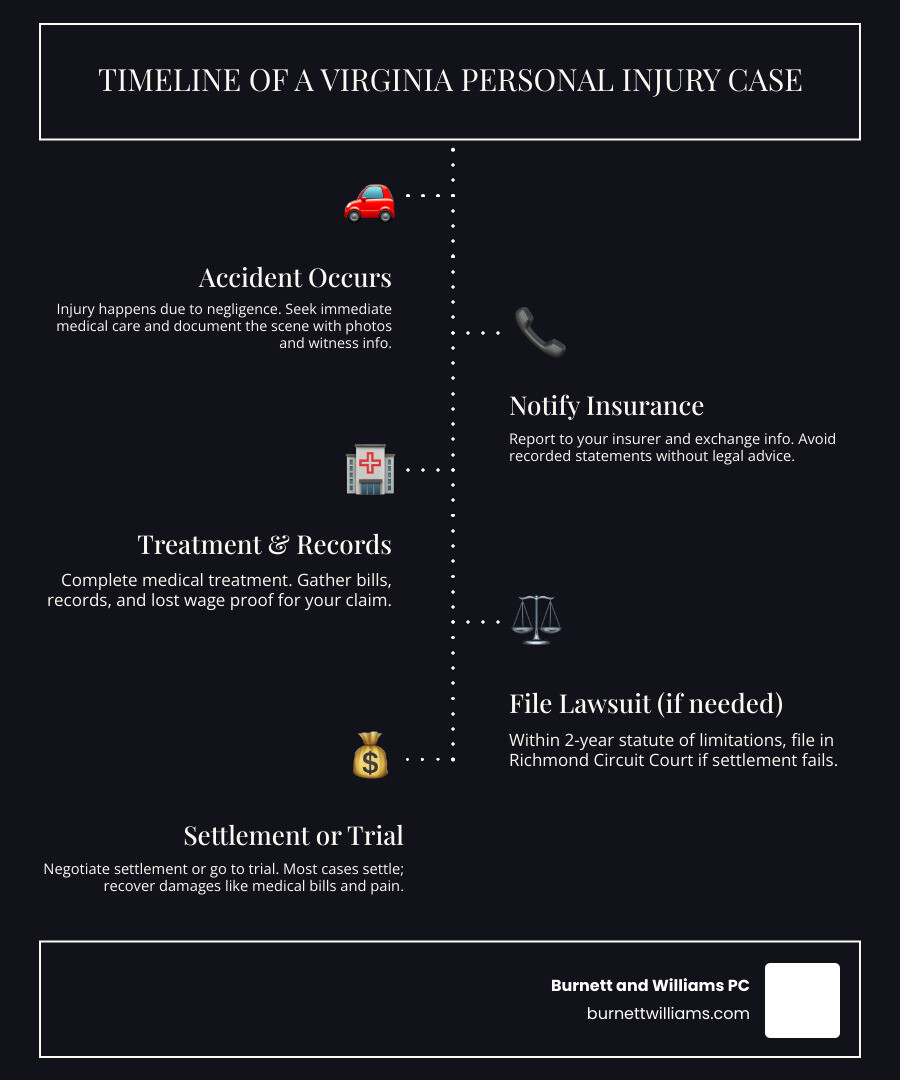
When you are injured in Virginia, the legal clock starts ticking immediately. In April 2026, the foundational rule remains the same: the statute of limitations. For the vast majority of personal injury cases in Virginia, you have exactly two years from the date of the accident to file a lawsuit in court. If you miss this window, you lose your right to seek compensation forever.
While two years might sound like a long time, building a successful case involves gathering medical records, interviewing witnesses, and negotiating with insurance companies. We often find that the best evidence is most available in the weeks following an accident. Waiting until the last minute can make it much harder to prove what really happened on the streets of Richmond or Chesterfield.
Navigating the local court system also requires specific procedural knowledge. Whether your case is heard at the Richmond Circuit Court or the John Marshall Courts Building, understanding local filings is vital. For a deeper dive into these regulations, you can explore our Virginia Personal Injury Law Complete Guide.
| Category | Statute of Limitations in Virginia |
|---|---|
| Personal Injury (Adults) | 2 Years from date of injury |
| Wrongful Death | 2 Years from date of death |
| Medical Malpractice | 2 Years (with some exceptions) |
| Minors (Under 18) | 2 Years from their 18th birthday |
Proving Negligence Under Richmond Personal Injury Law
To win a case, we must prove four specific elements of negligence. First is the duty of care, which is the legal obligation to act reasonably (like a driver staying focused on the road). Second is the breach of duty, where the person fails that obligation. Third is causation, proving the breach actually caused your injury. Finally, we must show actual damages, such as medical bills or lost income. Collecting evidence like dashcam footage, police reports, and medical statements is the only way to satisfy these requirements for Personal Injury Claims.
The Role of Local Expertise in Richmond Personal Injury Law
Every jurisdiction has its own “flavor.” A case handled in Henrico County may proceed differently than one in the City of Richmond or Chesterfield County. Local judges have specific expectations for how evidence is presented, and local court rules can dictate everything from filing deadlines to mediation requirements. Working with a team that knows these hallways and the people in them provides a distinct advantage. If you are looking for local representation, you can find more information about an Injury Lawyer Richmond VA.
The Impact of Virginia’s Pure Contributory Negligence Rule
Virginia is one of only a handful of states that still follows the “pure contributory negligence” rule. This is perhaps the most critical aspect of Richmond personal injury law to understand. In most states, if you are 10% at fault for an accident, you can still recover 90% of your damages. In Virginia, if you are found to be even 1% at fault, you are legally barred from recovering a single penny.
Insurance companies know this rule well. Their primary defense tactic is often to find some small way to pin a portion of the blame on you. They might argue you were walking too fast, didn’t look both ways long enough, or were slightly exceeding the speed limit on Broad Street. Because the stakes are “all or nothing,” having a robust defense against these allegations is essential. You can read more about this in our Virginia Personal Injury Attorney Guide 2026.
Examples of Contributory Negligence in Richmond Accidents
Contributory negligence pops up in many scenarios. For a Richmond Bicycle Accident Attorney, a common defense is that the cyclist wasn’t wearing reflective gear at night. In car accidents, an insurer might claim a driver failed to use a turn signal, even if the other driver was speeding. In slip and fall cases, the property owner might argue the victim should have seen the hazard. Even a tiny oversight can derail a multi-million dollar claim.
Strategies to Overcome Fault Allegations
To fight back against “1% fault” claims, we use every tool available. This includes securing surveillance footage from local Richmond businesses, obtaining detailed police reports from the Richmond Police Department, and working with accident reconstruction experts. By proving the other party was 100% liable, we protect your right to recovery. Our Richmond Auto Accident Lawyer Guide details how we build these high-stakes defenses.
Recoverable Damages and Compensation Caps in Virginia
If you’ve been hurt, you are likely facing a mountain of expenses. Under Virginia law, you can seek “economic” and “non-economic” damages. Economic damages are the objective costs: your bills from VCU Medical Center, your physical therapy invoices, and the wages you lost while you couldn’t work.
Non-economic damages are more subjective but just as real. This includes pain and suffering, mental anguish, and the loss of enjoyment of life. In cases involving a Richmond Brain Injury, these non-economic damages often make up the bulk of the claim because the lifestyle changes are so profound.
Maximizing Recovery in Richmond Personal Injury Law Claims
To get the full value of your claim, we look at the long-term picture. We don’t just look at the bills you have today; we calculate future medical costs and diminished earning capacity if you can no longer perform your old job. We also consider “loss of consortium,” which compensates for the impact the injury has on your relationship with your spouse. For more on this process, see From Crash to Cash Navigating Your Richmond Accident Claim.
Understanding Statutory Caps on Compensation
While Virginia generally does not cap total damages in standard personal injury cases, there are some specific limits you should know:
- Punitive Damages: Capped at $350,000 in Virginia.
- Medical Malpractice: Virginia has a statutory “ceiling” on total recovery for malpractice claims that increases slightly each year.
- Sovereign Immunity: Claims against the government or certain municipal entities have very strict limits and shorter notice requirements.
In tragic cases of fatal accidents, a Chesterfield Wrongful Death Attorney can help families navigate the specific recovery rules allowed for survivors.
Immediate Steps to Take After an Accident in Richmond
What you do in the first hour after an accident can dictate the success of your legal case. Your first priority is always safety. Seek medical attention immediately at a facility like Chippenham Hospital or VCU. Even if you feel “fine,” adrenaline can mask serious internal injuries or concussions.
Next, document everything. Use your phone to take photos of the vehicles, the road conditions, and any visible hazards. Exchange insurance information but keep the conversation brief. Never give a recorded statement to an insurance adjuster without a lawyer present. They are trained to ask “trap” questions designed to elicit an admission of fault. For a step-by-step walkthrough, check out our Richmond Car Accident Attorneys Complete Guide.
Why Trial Preparation Matters for Settlements
Most people want to avoid the stress of a courtroom, and indeed, many cases settle during the mediation process. However, the best way to get a high settlement is to prepare as if you are going to trial. When insurance companies see that we have gathered expert testimony and are ready to present a compelling case to a Richmond jury, they are much more likely to offer a fair amount. You can learn more about this dynamic in our article on Why Do Most Personal Injury Cases Settle.
Common Practice Areas for Richmond Attorneys
Personal injury law covers a wide range of accidents. At Burnett & Williams, we handle everything from Richmond Uber Accident Attorney cases to complex truck crashes. High-stakes litigation in Virginia has seen significant results, such as a $10,000,000 verdict for a catastrophic racing crash, a $9,000,000 settlement for a child injured by a store display, and a $1,500,000 verdict for an unsafe store entrance. Whether it’s a motorcycle crash or a premises liability claim, the goal is always the same: full accountability.
Frequently Asked Questions about Richmond Injury Laws
What is the statute of limitations for personal injury in Virginia?
In Virginia, you generally have a two-year window from the date of the injury to file a lawsuit. There are very limited exceptions, such as for incapacitated persons or minors, but for most adults, the two-year mark is a hard deadline. Missing it means your claim is over. Check our Richmond Personal Injury Guide 2025 for more details.
Can I recover money if I was partially at fault for my accident?
Because of Virginia’s pure contributory negligence rule, being even 1% at fault can prevent you from recovering any money. This is why it is vital to have an attorney who can investigate the facts and protect you from unfair blame. Learn more at Your Richmond Injury Compass Understanding Different Accident Claims.
How much does it cost to hire a Richmond injury lawyer?
Most Richmond injury lawyers, including our team, work on a contingency fee basis. This means there are no upfront costs to you. We only get paid if we win your case or secure a settlement. This ensures that everyone has access to high-quality legal help regardless of their bank account balance. For a look at how this works, see our Personal Injury Attorneys Complete Guide.
Conclusion
At Burnett & Williams PC, we believe that every accident victim deserves a voice. Richmond personal injury law is complex and often unforgiving, but you don’t have to navigate it alone. Our firm is known for responsive, caring service and a commitment to involving our clients in every major decision.
Whether you are in Midlothian, Chesterfield, or downtown Richmond, our team is ready to provide the expertise you need to stand up to insurance companies and secure the compensation you deserve. If you have questions about a recent accident or want to know more about these April 2026 legal updates, we are here to help.
Contact a Richmond Personal Injury Lawyer today for a free consultation and let us help you get your life back on track.