
Why Virginia Personal Injury Law is Different from Other States
VA personal injury law operates under some of the strictest rules in the country, and understanding these differences can mean the difference between receiving compensation and walking away with nothing.
Quick Facts About Virginia Personal Injury Law:
- Statute of Limitations: 2 years from the date of injury to file a lawsuit
- Contributory Negligence Rule: If you’re even 1% at fault, you recover nothing
- Damage Caps: No caps on most cases, but medical malpractice is capped at $2.7 million
- Court Jurisdiction: General District Court for claims under $50,000, Circuit Court for higher amounts
- Punitive Damages: Capped at $350,000 maximum
Virginia follows the strict rule of pure contributory negligence. This rule means that if an insurance company or defense attorney can prove you were even slightly at fault for your accident, you cannot recover any compensation at all.
The two-year deadline to file a lawsuit is also strict. Miss this deadline, and your case is likely over before it begins. For claims against government entities like cities, counties, or the state, these deadlines are even shorter.
If you’ve been injured in an accident on I-64 in Albemarle County, slipped and fell at a Culpeper business, or suffered harm due to medical negligence at a Virginia hospital, understanding these unique Virginia rules is critical to protecting your rights and securing fair compensation.
Key VA personal injury law vocabulary:
What Constitutes a Personal Injury Claim in Virginia?
When you’re injured because of someone else’s actions in Virginia, you might have grounds for a personal injury claim. But VA personal injury law has specific requirements that determine whether your case will succeed. Not every accident automatically becomes a winning lawsuit; Virginia courts need clear evidence that someone else was responsible for your harm and that you suffered real losses.
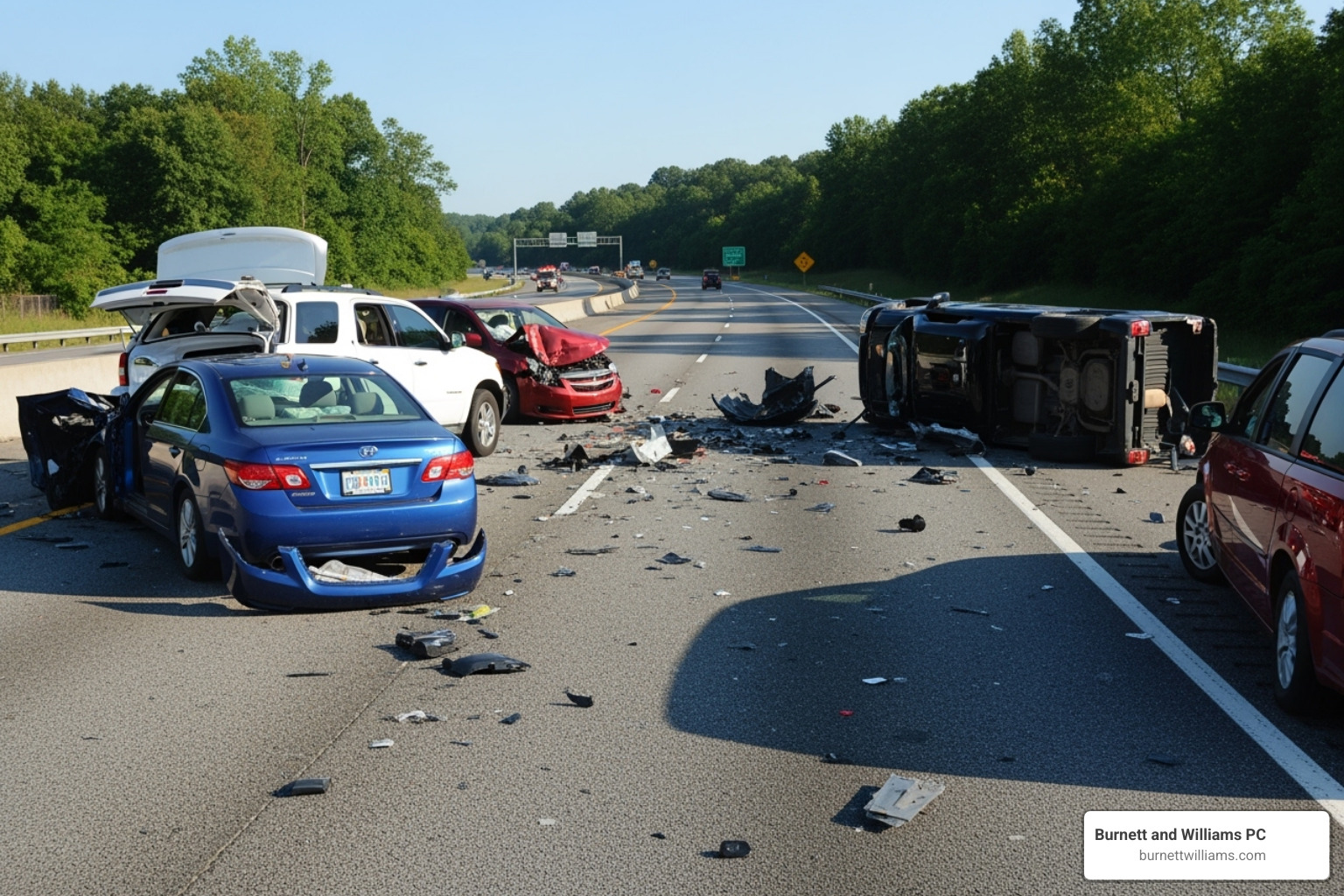
A personal injury claim exists when you suffer physical, emotional, or financial harm due to another’s negligence. This could be a broken bone from a car crash on Route 29 in Charlottesville or medical bills from a botched surgery at a local Virginia hospital.
Virginia is an “at-fault” state, meaning the person who caused the accident is responsible for your damages. If a distracted driver rear-ends you on Route 522 in Culpeper, their insurance should cover your medical bills, lost wages, and other losses.
The Foundation of a Claim: Proving Negligence
Proving negligence requires establishing four key elements. If any one is missing, your case could fail.
First, you must show the other party had a legal duty to act with reasonable care. For example, drivers have a duty to follow traffic laws, and store owners have a duty to keep their property safe.
Second, you must prove that duty was breached. This could be a driver who was texting, a doctor who failed to diagnose a condition, or a store owner who ignored a spill.
Third, you must establish causation, showing the breach of duty directly caused your injuries. Proving that a crash worsened a pre-existing back problem, for instance, requires careful documentation.
Fourth, you must demonstrate actual harm. This means real damages like medical bills, lost income, or pain and suffering. Without demonstrable harm, there is no case.
Because of Virginia’s strict fault rules, proving the other party was 100% responsible is critical.
Common Types of Personal Injury Cases in Virginia
Motor vehicle accidents are a large portion of personal injury cases in Virginia, from fender-benders on the Beltway to serious truck collisions on I-95.
Slip and fall incidents occur when property owners fail to maintain safe conditions, such as a wet floor at a Kroger in Richmond or uneven pavement outside a Virginia Tech building.
Medical malpractice claims are challenging in Virginia. They require certification from another medical professional that the care you received fell below the accepted standard and directly caused your harm.
Product liability issues arise when defective products cause injury. Virginia’s Product Liability Act covers cases involving design flaws, manufacturing defects, or inadequate warnings. However, you cannot recover if you misused the product in an unforeseeable way.
Wrongful death actions are filed when negligence causes a person’s death. Virginia law allows certain family members to seek compensation for their financial losses, medical and funeral expenses, and loss of companionship.
Critical Virginia Rules: Contributory Negligence and Filing Deadlines
If you’ve been injured in Virginia, two legal realities can make or break your case. VA personal injury law has some of the strictest rules in the country, and understanding them is essential.
The first rule is shocking: if you are even slightly at fault, you could get nothing. The second is just as unforgiving: miss your filing deadline, and your case is over. These are not just technicalities; they are why insurance companies fight so hard in Virginia.
Virginia’s Harsh Contributory Negligence Rule
In Virginia, if you are found even 1% at fault for your accident, you cannot recover any compensation. It does not matter if the other party was 99% responsible. This “all or nothing” rule is called pure contributory negligence.
For example, imagine another driver runs a red light in Richmond and hits you, causing serious injuries. If an investigation reveals you had a burned-out taillight, a defense attorney could argue you were contributorily negligent. This argument, even if the taillight had nothing to do with the crash, could prevent you from recovering any money.
This rule places a huge burden of proof on you to show the other party was 100% at fault. Insurance companies exploit this by searching for any way to assign a small amount of blame to you.
The Statute of Limitations: Your Deadline to File a Lawsuit
Virginia gives you two years from the date of your injury to file a lawsuit. Virginia law on personal injury time limits is strict, and courts rarely grant exceptions.
The two-year window closes quickly while you are recovering and dealing with insurers. Insurance adjusters know this and may deliberately drag out negotiations, hoping you run out of time.
The clock starts on the day of the injury, but some exceptions apply. The deadline may be extended for minors or mentally incapacitated individuals.
Wrongful death claims also have a two-year deadline, starting from the date of death.
Do not wait to seek legal help. Virginia’s unforgiving rules mean every day counts.
Understanding Compensation: Damages in a VA Personal Injury Law Case
When someone else’s negligence harms you in Virginia, the law allows for monetary awards called “damages” to help restore what you’ve lost. Understanding what you might recover is crucial for making informed decisions about your case.
_compressed.png?alt=media&token=aa1f529a-143a-410a-b823-55920e00f3ab "Calculator and medical bills, VA personal injury law")
VA personal injury law divides damages into categories to make you whole again, aiming to put you in the position you would have been in if the accident never happened.
What Types of Damages Can You Recover?
Virginia courts recognize that an injury affects your life in many ways, some with clear costs and others that are harder to measure.
Economic damages cover your measurable financial losses. These include all past and future medical expenses, from an ambulance ride after a crash on Route 15 in Orange County to long-term physical therapy. They also cover lost wages and benefits for missed work. If your injuries prevent you from returning to your job, you may also recover for diminished earning capacity. Property damage, such as vehicle repair costs, is also included.
Non-economic damages address the non-financial impact on your life. This includes pain and suffering for physical discomfort and emotional distress like anxiety or depression. Compensation for inconvenience recognizes the loss of enjoyment of life when you can no longer pursue hobbies or daily activities.
In cases of extreme misconduct, like that of a drunk driver on I-64 near Charlottesville, Virginia courts may award punitive damages. These are intended to punish the wrongdoer and deter similar behavior, not to compensate you for your losses.
Are There Caps on Damages in Virginia?
Virginia does not cap damages in most personal injury cases. A jury can award what it believes is fair compensation for your pain and suffering in a typical car accident or slip-and-fall case.
However, two important exceptions exist. Medical malpractice cases have a total damage cap that applies to all forms of compensation. This cap, established by state law for medical malpractice cases, is currently $2.7 million and increases annually.
Punitive damages are also capped. Virginia law limits punitive damages to a maximum of $350,000 in all personal injury cases.
Understanding these rules helps set realistic expectations. The absence of caps in most cases makes thorough documentation of all your damages even more critical to securing a fair outcome.
The Legal Journey: From Insurance Claim to Lawsuit
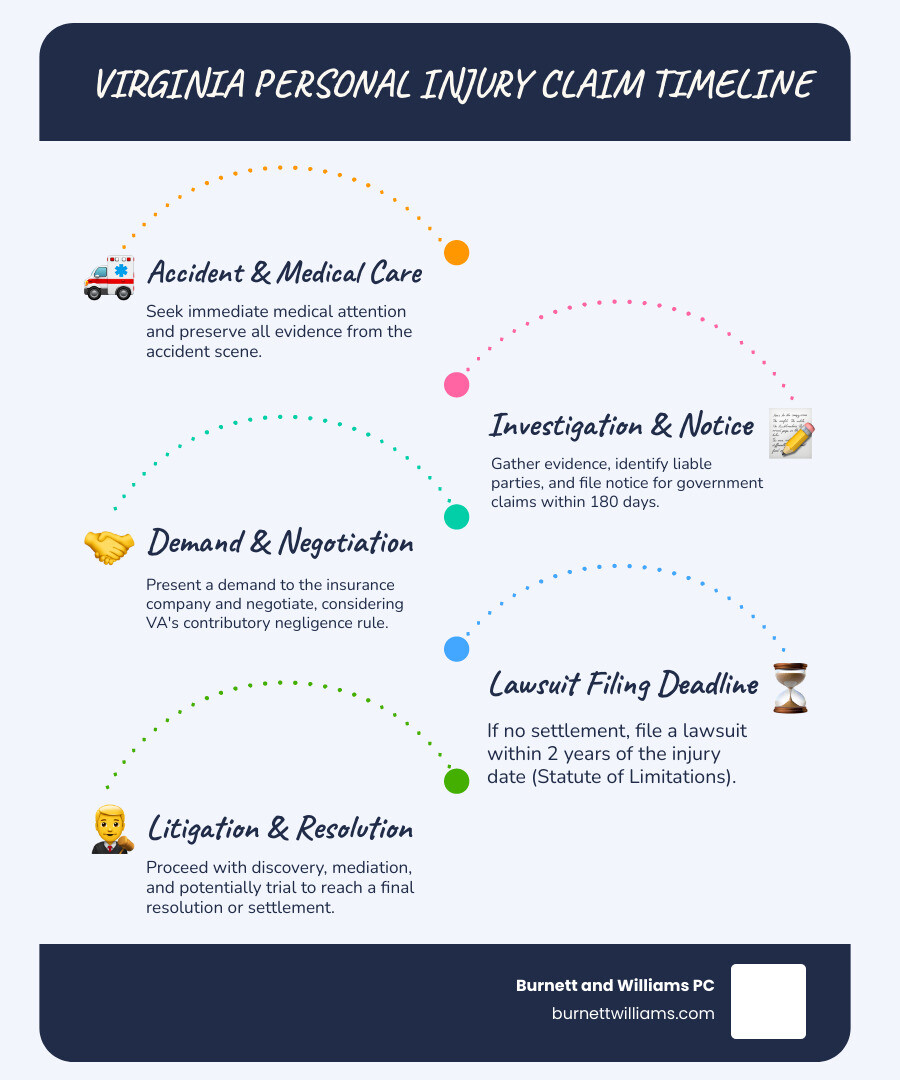
Understanding the path from an insurance claim to a potential lawsuit is key to navigating VA personal injury law. Most cases start with an insurance claim, but a formal lawsuit may be needed if negotiations fail.
| Feature | General District Court | Circuit Court |
|---|---|---|
| Jurisdiction | Claims up to $50,000 (though some sources state $25,000, $50,000 is more common for current cases) | Claims exceeding $50,000 |
| Jury Trials | No jury trials at this level; cases are heard by a judge. Appeals go to Circuit Court for a new trial with a jury of five. | Offers jury trials. A unanimous decision by seven jurors is typically required for a verdict in a civil personal injury case. |
| Complexity | Generally handles less complex cases, often resolved more quickly. | Handles more complex cases, including those with significant injuries or multiple parties. |
Filing an Insurance Claim vs. a VA Personal injury Law Lawsuit
Most Virginia personal injury cases begin by filing a claim with the at-fault party’s insurer. We start by gathering evidence like police reports, witness statements, medical records, and photos of the accident scene, whether on I-95 near Richmond or Route 29 in Charlottesville.
Timing is crucial. We often wait until you reach Maximum Medical Improvement (MMI), the point where your condition has stabilized, before negotiating a settlement. This allows us to accurately calculate your total damages, including long-term medical needs from a Fairfax County car accident or a Winchester slip and fall.
We then prepare a comprehensive demand letter that outlines the facts, details your injuries, and demands fair compensation. Since insurance adjusters aim to minimize payouts, we negotiate firmly on your behalf.
If the insurance company refuses to offer a reasonable settlement, filing a lawsuit is the next step. This moves the case into Virginia’s court system, starting with a formal complaint against the defendant.
Navigating the Virginia Court System
Virginia’s courts divide cases based on the amount of damages sought.
General District Court handles claims up to $50,000. A judge, not a jury, hears these cases. Outcomes can be appealed to the Circuit Court for a new trial with a jury. These cases are typically faster and suitable for more straightforward incidents.
Circuit Court handles claims over $50,000 and is where more serious injury cases are heard. It offers full jury trials, which usually require a unanimous verdict from seven jurors. These courts manage complex cases involving severe injuries or medical malpractice.
If a settlement isn’t reached after findy, the case may proceed to trial. While most cases settle, the court system provides the necessary path to pursue fair compensation.
Why an Experienced Virginia Attorney is Crucial
When dealing with VA personal injury law, the right attorney can mean the difference between fair compensation and walking away with nothing. Virginia’s harsh contributory negligence rule and strict deadlines create a challenging legal landscape.

Insurance companies know Virginia’s rules and use them to their advantage. They will try to prove you were slightly at fault to avoid paying anything, or they will use delay tactics to make you miss filing deadlines. An experienced Virginia personal injury attorney understands these tactics and knows how to build a case that protects you.
Fighting Back Against the Contributory Negligence Defense
Virginia’s pure contributory negligence rule is the biggest threat to your claim. Proving the other party was 100% at fault is critical.
Our first step is immediate evidence gathering. We collect police reports, witness statements, photos, and surveillance footage before it disappears. This often involves visiting the accident scene, whether on Route 460 in Petersburg or elsewhere, to document conditions and interview witnesses who can provide compelling testimony about who was at fault.
The Importance of Uninsured/Underinsured Motorist (UM/UIM) Coverage
Virginia law allows drivers to pay a fee to drive without liability insurance, increasing your risk of being hit by an uninsured driver. Uninsured/Underinsured Motorist (UM/UIM) coverage protects you in these situations, as well as in hit-and-run accidents.
Understanding your UM/UIM policy, including options like “stacking” coverage from multiple vehicles, can be complex. An attorney can help you steer your policy and ensure you receive the benefits you are entitled to. Even though it is your own insurance company, they are still focused on minimizing payouts, so having an advocate is crucial.
Another important concept is joint and several liability. If multiple parties are at fault, you may be able to collect your full award from a single party, which is valuable if one defendant has better insurance coverage.
At Burnett & Williams PC, our responsive, caring approach means we handle the legal complexities while keeping you informed. We are always available to answer your questions and address your concerns.
Conclusion
Navigating a personal injury claim in Virginia means facing some of the strictest rules in the country. The harsh VA personal injury law, particularly the contributory negligence rule and tight deadlines, can jeopardize your right to compensation. Insurance companies know these rules and use them to deny or reduce claims.
You don’t have to face this challenge alone. At Burnett & Williams PC, we understand how Virginia’s unique laws affect people with serious injuries. We know how to build a case that proves the other party was completely at fault and how to steer the court system to protect your rights.
Our approach is built on responsive, caring client service. We believe your case is about your life and your family’s security. We work to secure the fair compensation you deserve so you can focus on getting better.
If you’ve been injured by someone else’s negligence, don’t let Virginia’s tough laws stop you from seeking justice. Time is limited, but experienced legal guidance can level the playing field.
Find an experienced attorney in Orange, VA and take the first step toward protecting your rights.