
Is Your Personal Injury Case Strong? Here’s What a Case Review Actually Tells You
A personal injury case review is a free, confidential meeting with a licensed attorney where you share the facts of your accident and get an honest assessment of whether you have a viable claim.
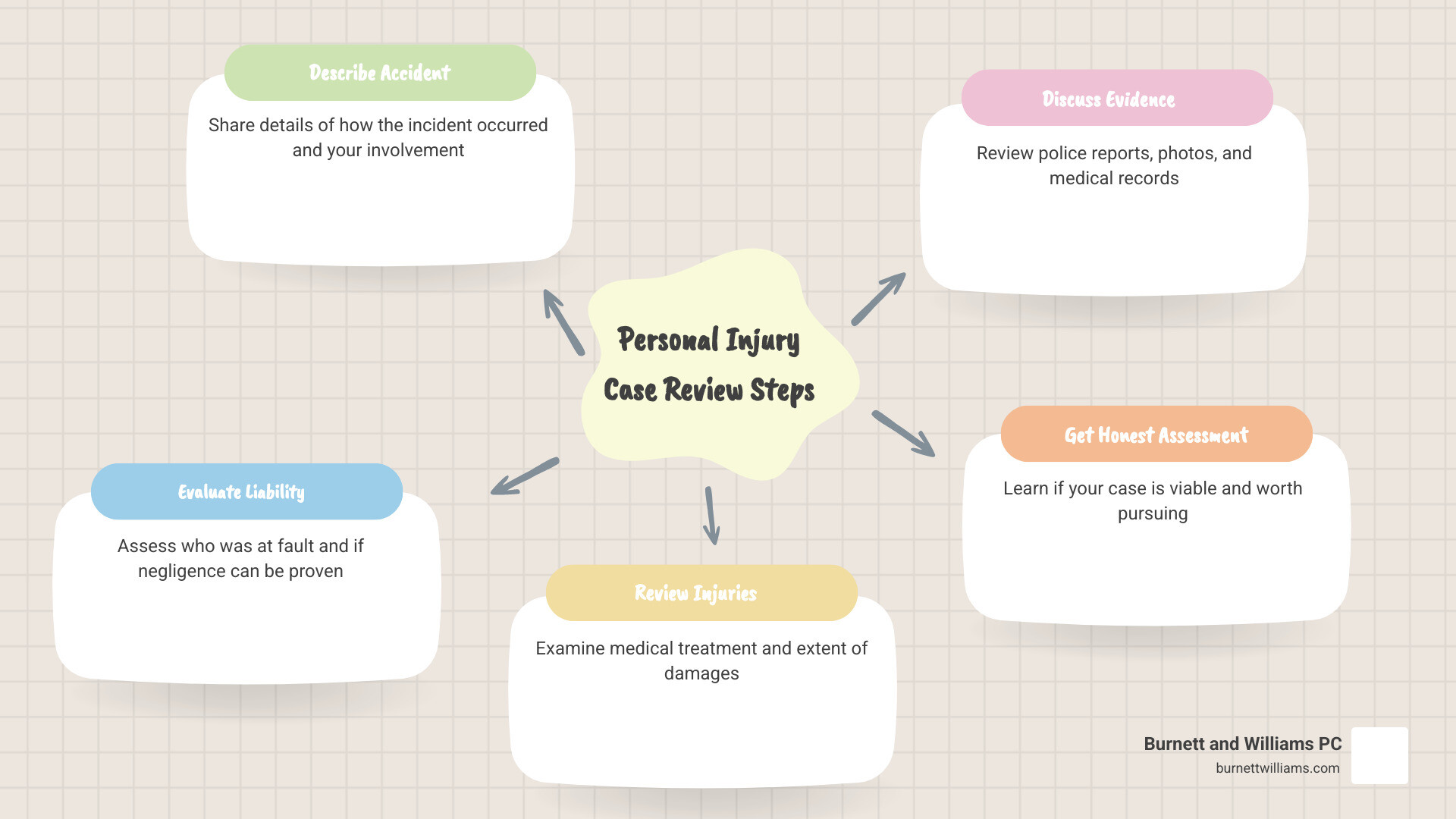
Here is what happens in a typical review:
- You describe the accident and how it happened
- The attorney evaluates liability, meaning who was at fault and whether negligence can be proven
- Your injuries and medical treatment are reviewed to assess damages
- Evidence is discussed, including police reports, photos, and medical records
- You get an honest answer about whether your case is worth pursuing
No fees. No obligation. No pressure.
If you were recently hurt in an accident in Virginia, you are probably dealing with a lot at once. Medical appointments. Insurance calls. Missed work. It can feel completely overwhelming.
The good news is that a case review gives you clarity quickly. You do not have to figure out whether you have a case on your own.
What matters most right now is understanding two things: what your claim might be worth, and whether Virginia law supports it. Virginia has some of the strictest personal injury rules in the country, including a contributory negligence standard that can block your recovery entirely if you are found even slightly at fault. That makes getting an early, honest case review especially important.
The sections below walk you through exactly what to expect, step by step.
Quick look at Personal injury case review:
What to Expect During a Personal Injury Case Review
When you sit down with us for a personal injury case review, our primary goal is fact-finding. We want to hear your story in your own words. This initial meeting is a safe space where attorney-client privilege applies, meaning everything you tell us stays confidential. We will look at the timeline of events to determine if another party’s negligence caused your harm.
A major part of this process is a Free Consultation Injury Lawyer assessment. We look for “viability,” which is a fancy legal way of asking: “Can we win this in a Virginia court?” We provide personalized advice based on the specific details of your accident, whether it happened on U.S. Route 522 in Orange or a busy intersection in Culpeper.
Preparing Your Personal Injury Case Review Documents
To get the most out of your review, it helps to be organized. Think of yourself as a detective gathering clues. You should bring any police reports from the scene, all medical bills you have received so far, and any letters from insurance companies. If you have photos of the accident or your injuries, those are incredibly helpful.
We also suggest bringing contact information for any witnesses and your employment records if you have missed work. For a deeper dive into what you might need, check out our Personal Injury Claim Complete Guide. Having these documents ready allows us to give you a much more accurate estimate of your case’s strength.
The Role of Credibility and Evidence
In the legal world, evidence is king, but credibility is the crown. During a personal injury case review, we look at how consistent your story is. If your description of the accident matches the physical evidence and the medical records, your case becomes much stronger.
Honesty is vital. It is much better to discuss potential “weak spots” in your case with us early on than to have the insurance company surprise us with them later. We may also discuss the need for expert testimony, such as medical experts, who can explain the long-term impact of your injuries.
Proving Negligence Under Virginia Law
To win a personal injury case in Virginia, you must prove negligence. This involves four specific steps: duty of care, breach of that duty, causation, and damages. Essentially, we must show that someone had a responsibility to act safely, they failed to do so, that failure caused your injury, and you suffered real losses as a result.
Understanding Virginia Personal Injury Law is critical because our state has unique standards. We focus on building a rock-solid argument that leaves little room for the defense to wiggle out of their responsibility.
The Impact of Virginia’s Strict Contributory Negligence Rule
This is the part where Virginia law gets tough. Virginia follows a “pure contributory negligence” rule. This means that if you are found to be even 1% at fault for the accident, you are legally barred from recovering any compensation. It is a favorite tactic for insurance defense lawyers to try and shift a tiny bit of blame onto the victim.
Before you ask, “Do I Have a Case for My Serious Injury?“, we need to investigate the accident thoroughly. We look for any evidence that could be used against you to ensure we can protect your right to recovery. This is why we tell our clients: do not admit fault at the scene and do not give recorded statements to insurance adjusters without talking to us first.
Common Types of Cases Reviewed
We review a wide variety of Personal Injury Claims every day. Many of these involve car accidents, particularly high-speed crashes on I-95 or I-64. Other common cases include:
- Slip and Fall Accidents: Often occurring in retail spaces or icy parking lots.
- Medical Malpractice: When a healthcare provider fails to meet the standard of care.
- Product Liability: Injuries caused by defective tools, appliances, or safety gear.
- Wrongful Death: Seeking justice for families who have lost a loved one due to negligence.
Calculating the Potential Value of Your Claim
One of the first questions people ask during a personal injury case review is, “How much is my case worth?” The answer depends on your “damages.” Economic damages are the easiest to calculate because they have a specific dollar amount attached. This includes all medical expenses, from the ambulance ride to future physical therapy.
It also covers lost wages if you cannot work. We look at your economic damages.
Non-Economic Damages in a Personal Injury Case Review
Not every loss comes with a receipt. Non-economic damages cover things like pain and suffering, emotional distress, and the loss of enjoyment of life. These are more subjective, and their value often depends on jury perception.
Our goal is to make sure the insurance company sees you as a human being, not just a claim number.
Understanding Contingency Fees and Costs
We believe that everyone should have access to high-quality legal help. That is why we work on a contingency fee basis. This means there are no upfront costs to hire us. We only get paid an attorney fee if we win your case, taking a pre-agreed percentage of the final settlement or verdict.
So, What Does a Personal Injury Lawyer Do? We typically cover the costs of filing fees, copies, accident reports, etc. This allows you to focus on your physical recovery while we handle your case.
The Timeline from Review to Resolution
Patience is a virtue, especially in law. A typical case does not resolve overnight. First, you must reach Maximum Medical Improvement (MMI). This is the point where your doctor says your condition has stabilized. We cannot accurately value your claim until we know the full extent of your medical needs.
Once you reach MMI, we send a demand letter to the insurance company. If they refuse to offer a fair settlement, we may file a lawsuit. We also monitor the Personal Injury Cases and Virginia Statute of Limitations closely. In Virginia, you generally have two years from the date of the accident to file a lawsuit. Our Case Investigation starts immediately to ensure no deadlines are missed.
Why Most Cases Settle Out of Court
While we are always prepared to go to trial, about 95% of personal injury cases end in a settlement. Trials are expensive, time-consuming, and unpredictable. Often, both sides prefer the certainty of a negotiated agreement.
We often use mediation or settlement conferences to reach these deals. A neutral third party helps both sides find common ground. This is usually the most efficient way to get you the compensation you need so you can move on with your life.
Frequently Asked Questions About Case Reviews
How long do I have to start a claim in Virginia?
In most cases, you have two years from the date of the injury. However, there are exceptions for minors or claims against government entities. It is always best to start your personal injury case review as soon as possible while evidence is fresh.
Should I speak to the insurance company before my review?
We strongly advise against it. Insurance adjusters are trained to find reasons to deny your claim or pay you as little as possible. Let us handle the communication so you do not accidentally say something that hurts your case.
What happens if the case review is positive?
If we believe you have a strong case and you decide to hire us, we hit the ground running. We will take over all communication with the insurance companies, continue the investigation, and begin building your formal case for compensation.
Conclusion
At Burnett & Williams PC, we pride ourselves on being responsive and caring advocates for our neighbors across Virginia, from Leesburg to Richmond. A personal injury case review is the first step toward reclaiming your future after a serious accident.
If you are ready to get the answers you need, explore our VA Personal Injury Law Complete Guide or Contact our Orange Virginia office today to schedule your free consultation. We are here to help you navigate the road to recovery.