
What a Whiplash Injury Lawyer Can Do for You in Virginia
A whiplash injury lawyer helps accident victims in Virginia navigate insurance disputes, gather medical evidence, and pursue fair compensation for neck injuries caused by someone else’s negligence. If you were recently hurt in a rear-end collision or similar accident, here is what you need to know right away:
Quick answers for whiplash injury victims in Virginia:
- You have two years from the date of your accident to file a personal injury lawsuit in Virginia.
- Virginia follows a strict contributory negligence rule, meaning any fault on your part can bar your recovery.
- Whiplash injuries often do not show up on X-rays, making medical documentation and legal strategy critical.
- Insurance companies frequently minimize or deny whiplash claims, calling them minor or pre-existing.
- A qualified whiplash injury lawyer can handle all communication with insurers and build the evidence your case needs.
Whiplash is one of the most common injuries in car accidents, yet it is also one of the most misunderstood. Approximately 3 million whiplash cases are reported across the United States every year, roughly 342 every single hour. Despite how common it is, insurers routinely push back on these claims, arguing the injury is not serious or was not caused by the crash.
That is a real problem, especially in Virginia, where the legal rules are stricter than most other states. The wrong move early on, like accepting a quick settlement or giving a recorded statement, can cost you your right to full compensation.
You deserve clear answers and a steady hand guiding you through this. That is exactly what this guide is here to provide.
Understanding Whiplash and Its Long-Term Impact
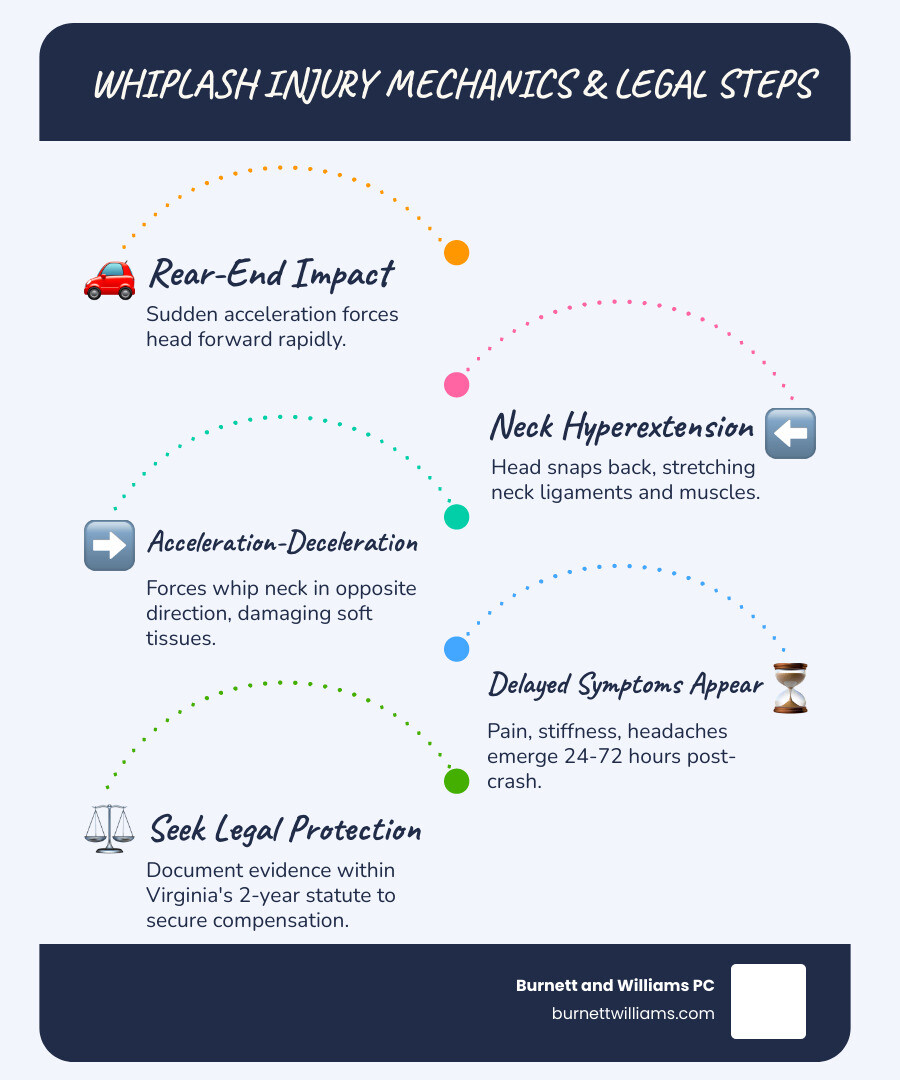
Whiplash occurs when the head is suddenly and forcefully jerked forward and then backward, or vice versa. This rapid acceleration and deceleration create a whip-like motion that stretches and tears the soft tissues in the neck beyond their normal range of motion. While often associated with high-speed crashes on I-81 or I-95, research shows that whiplash can occur in low-speed accidents of less than 5 to 10 miles per hour.
One of the most deceptive aspects of this injury is the delayed onset of symptoms. You might walk away from a fender bender in Winchester feeling fine, only to wake up three days later unable to turn your head. This delay happens because inflammation and internal bruising take time to manifest. According to the Mayo Clinic, whiplash symptoms can be delayed and may persist for several weeks. Because these are soft tissue injuries, they often do not appear on standard X-rays, which only show bone fractures. This “invisibility” is why insurance adjusters often try to claim you aren’t actually hurt.
The long-term impact can be significant. It typically takes about 17 weeks for the neck to stabilize and re-strengthen after a traumatic whiplash event. However, for some, the pain never fully goes away. One study found that three-quarters of individuals with severe whiplash were still symptomatic one year after their accident. For more detail on the physical toll, you can read more about car crash neck pain and how it affects your daily life.
Common Symptoms and Red Flags
If you have been in an accident, watch for these common whiplash symptoms, which may appear immediately or days later:
- Neck stiffness and decreased range of motion: Feeling like your neck is “locked” or experiencing sharp pain when turning your head.
- Cervicogenic headaches: These are headaches that start at the base of the skull and radiate toward the forehead.
- Radiating pain: Pain that travels from the neck down into the shoulders, upper back, or even the arms.
- Tingling and numbness: A “pins and needles” sensation in the arms or hands, which may indicate nerve irritation or a herniated disc.
- Cognitive and emotional issues: Dizziness, fatigue, blurred vision, and even difficulty concentrating or sleeping are common secondary symptoms of severe whiplash.
Why You Need a Whiplash Injury Lawyer in Virginia
Navigating a whiplash claim in Virginia is notoriously difficult because of the state’s unique legal landscape. Virginia is one of the few remaining states that uses a “pure contributory negligence” rule. This means that if you are found to be even 1% at fault for the accident, you are legally barred from recovering any compensation at all. Insurance companies know this and will look for any excuse: a late turn signal, a slightly worn tire, or a vague statement you made at the scene, to shift a tiny fraction of blame onto you.
A whiplash injury lawyer acts as your shield against these tactics. Because whiplash is an “invisible” injury, insurers often use a “minor impact, minor injury” argument. They suggest that if there is little damage to the vehicles, there cannot be significant damage to the human body. We know this isn’t true, but proving it requires a specific legal strategy. Our Virginia neck injury lawyer ultimate guide explains how we counter these arguments by focusing on the biomechanics of the crash rather than just the repair bill.
Proving Your Case with a Whiplash Injury Lawyer
To win a whiplash case in Virginia, we must bridge the gap between your pain and the medical evidence. Since X-rays often come back “normal,” we rely on more advanced documentation and expert insights:
- Specialized Imaging: We may recommend seeking an MRI or CT scan through providers like Winchester Medical Center or Inova Loudoun. These scans can reveal soft tissue damage, such as torn ligaments or bulging discs, that X-rays miss.
- Expert Testimony: We often work with medical experts or accident reconstructionists who can explain to a jury how a low-speed impact can still generate enough force to cause permanent neck damage.
- Consistent Treatment Records: The most important evidence is a consistent “paper trail” of your recovery. Gaps in treatment are the primary reason insurance companies deny claims. We help ensure your medical records accurately reflect your symptoms and your efforts to heal.
- Symptom Journals: We encourage our clients to keep a daily log of how the injury affects their life, whether they can’t lift their child, had to miss work in Leesburg, or can’t sleep due to pain. This provides the “human element” that medical codes cannot capture.
Navigating Virginia Law and Compensation
When we file a neck injury lawsuit in Petersburg, VA, or anywhere else in the Commonwealth, we are seeking “damages” to make you whole again. In Virginia, the burden of proof is on the injured person to show that the other driver was 100% negligent.
| Type of Damage | What it Covers | Examples |
|---|---|---|
| Economic Damages | Measurable financial losses | Medical bills, lost wages, prescriptions, physical therapy costs. |
| Non-Economic Damages | Subjective, non-monetary losses | Pain and suffering, emotional distress, loss of enjoyment of life. |
In Virginia, you generally have a two-year statute of limitations to file your claim. While two years might seem like a long time, evidence disappears quickly. Skid marks fade, witnesses move away, and your own memory of the event can become less sharp. Starting early allows us to preserve the evidence needed to meet Virginia’s strict liability standards.
Calculating Damages with a Whiplash Injury Lawyer
How much is a whiplash claim worth? There is no “magic calculator,” but several factors influence the final number. A whiplash injury lawyer will look at the total cost of your medical bills, the amount of time you missed from your job in Leesburg or Culpeper, and the severity of your ongoing pain.
Once you sign a settlement agreement, you cannot go back and ask for more money later if your neck pain gets worse. This is why we wait until you have reached “Maximum Medical Improvement” before finalizing a claim.
Steps to Take After a Neck Injury in Virginia
What you do in the minutes and days following an accident on a busy road like I-81 or I-64 can make or break your legal case.
- Seek Medical Attention Immediately: Even if you feel “fine” or just a little “shaken up,” go to an emergency room or urgent care. Mention any neck stiffness or headaches. This creates a medical record linking the accident to your injury.
- Call the Police: A formal police report is a vital piece of evidence. It provides an objective third-party account of the accident and often includes the officer’s opinion on who was at fault.
- Document the Scene: If you are physically able, take photos of both vehicles, the surrounding area, and any visible injuries. If there were witnesses near a shop in Winchester or a stoplight in Orange, get their contact information.
- Report to Your Insurance, but Be Careful: You must notify your own insurance company, but you are not required to give a recorded statement to the other driver’s insurance company. In fact, we strongly advise against it.
- Follow Your Doctor’s Orders: If a doctor at Mary Washington Hospital or Winchester Medical Center prescribes physical therapy, go to every session. If you skip appointments, the insurance company will argue that you aren’t actually hurt.
Avoiding Common Pitfalls in Virginia Claims
The biggest mistake victims make is talking to insurance adjusters before speaking with a lawyer. Adjusters are trained to be friendly and helpful, but their goal is to settle your case for as little as possible. They may offer a “quick settlement” of $500 or $1,000 just days after the crash. While that might cover your immediate deductible, it won’t cover the six months of physical therapy you might realize you need three weeks later.
Another major pitfall is the contributory negligence trap. An adjuster might ask, “Is it possible you were going a mile or two over the speed limit?” If you say “yes,” you may have just admitted to being partially at fault, which could end your case under Virginia law.
Frequently Asked Questions about Whiplash Claims
How long do I have to file a whiplash lawsuit in Virginia?
In Virginia, you generally have two years from the date of the injury to file a lawsuit. It is always best to consult a lawyer as soon as possible to ensure no deadlines are missed.
Can I recover compensation if the accident was partially my fault?
Unfortunately, no. Because of Virginia’s strict contributory negligence rule, if you contributed to the accident in any way, even just 1%, you are generally barred from recovering damages from the other party. This makes the investigation phase of your case incredibly important.
Why do insurance companies often deny whiplash claims?
Insurers often view whiplash as a “subjective” injury. Since they can’t see a broken bone on an X-ray, they claim the victim is exaggerating. They also frequently argue that the pain is due to “pre-existing” age-related wear and tear in the neck rather than the accident itself.
Conclusion
A whiplash injury can be much more than a “pain in the neck.” It can disrupt your ability to work, care for your family, and enjoy your life. Because of Virginia’s difficult legal rules and the “invisible” nature of soft tissue damage, these cases require a high level of medical and legal expertise.
At Burnett & Williams PC, we pride ourselves on being responsive, caring, and deeply involved in our clients’ recovery. Whether you are in Leesburg, Winchester, or Orange, our team is ready to help.
If you are struggling with neck pain after an accident, don’t navigate this alone. Contact our experienced legal team for a free consultation today to discuss your rights and your path forward.