
When Heavy Machinery Goes Wrong in Richmond – Richmond Construction Sites
Richmond heavy machinery accidents can change lives in seconds. If you or someone you love has been hurt on a construction site, you are likely looking for fast, clear answers.
Here is a quick overview of what matters most:
| Key Topic | Quick Answer |
|---|---|
| Common machines involved | Excavators, forklifts, backhoes, dump trucks, cranes |
| Who can be liable | Employers, contractors, equipment manufacturers, property owners |
| Virginia filing deadline | Two years from the date of injury for personal injury claims |
| Compensation available | Medical bills, lost wages, pain and suffering, disability benefits |
| First steps after an accident | Seek medical care, report to employer, document everything, contact an attorney |
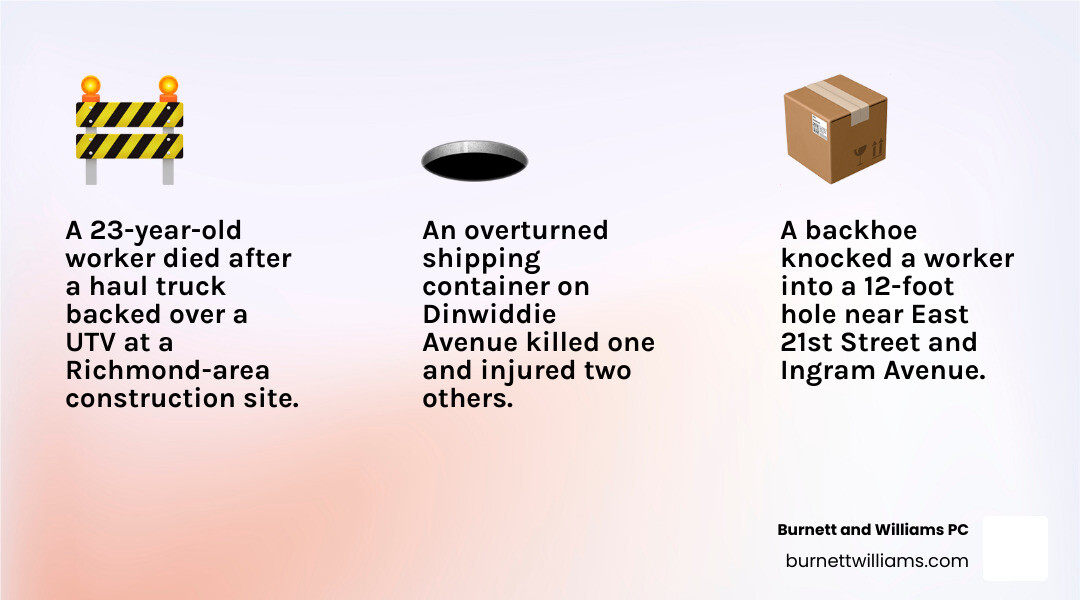
Richmond’s construction industry is growing fast, and with that growth comes serious risk. A 23 year old Richmond man was killed when a Cat Haul Truck backed over a utility task vehicle at a construction site in Stafford County. That single incident involved multiple investigating agencies, including the Stafford Sheriff’s Office and OSHA, and left a family with devastating questions about accountability. Due to their sheer size, these incidents share many legal complexities with standard commercial truck accidents in Virginia.
He was not the only one. A worker was knocked into a 12 foot hole by a backhoe near East 21st Street and Ingram Avenue. A shipping container overturn on Dinwiddie Avenue killed one person and injured two more. These are not isolated events. They reflect a pattern of preventable harm on Richmond area job sites.
If you are recovering from an injury or grieving a loss, this guide walks you through what happened, why it happens, and what Virginia law allows you to do about it.
Common Richmond heavy machinery accident vocab:
Recent Richmond Heavy Machinery Accident Reports and Trends
In the spring of 2024, a frightening incident occurred at a construction site near East 21st Street and Ingram Avenue in Richmond’s Southside. A man was working when he was struck by a backhoe, a common type of excavating equipment. The force of the impact threw him into a 12-foot ditch. Richmond Fire and EMS had to perform a complex rescue, as construction holes present unique risks like soil collapse and atmospheric changes. Fortunately, the worker survived with non-life-threatening injuries, but the incident highlighted how quickly a routine day can turn catastrophic.
Another tragic event took place in the 800 block of Dinwiddie Avenue when a shipping container overturned while three men were loading metal materials. The uneven weight distribution caused the massive steel box to tip, trapping the workers inside. One person lost their life, and two others were seriously injured. These cases show that whether it is a moving vehicle or a stationary container, the sheer weight of industrial equipment is unforgiving. If you find yourself in a similar situation, it is vital to understand your Richmond injury compass and how different accident claims work.
Fatalities and Wrongful Death in Richmond Industrial Accidents
The loss of Brody Beverly at the Amazon facility site in Stafford County remains a sobering reminder of the stakes involved in heavy equipment operation. Brody, a 23-year-old Richmond resident, was operating a UTV when an oversized Cat Haul Truck backed over him. These massive off-road dump trucks have significant blind spots, and without rigorous spotting protocols, smaller vehicles like UTVs are nearly invisible to the operator.
When a Richmond heavy machinery accident results in a fatality, the family has the right to pursue a wrongful death claim. Under Virginia law, these claims seek to provide financial security for survivors, covering funeral expenses and the loss of the loved one’s future income and companionship. Fatalities often trigger deep investigations by the Occupational Safety and Health Administration (OSHA) and local law enforcement to determine if safety shortcuts led to the tragedy.
Historical OSHA Findings in the Greater Richmond Area
Looking back at Virginia’s industrial history helps us understand modern safety regulations. One of the most significant incidents occurred in December 1999 during the construction of the I-895 bridge in Richmond. An 80-ton reinforcing steel cage, standing 44 feet tall, collapsed while two workers were near the top. One worker was killed in the fall.
The OSHA investigation found that the cage lacked adequate lateral support. While guy wires were used, they were only intended to “plumb” the cage (keep it straight) rather than provide structural bracing against wind. On that day, 20-25 mph winds were enough to trigger the collapse. This landmark case reinforced the necessity of strict adherence to OSHA accident reporting and safety standards to prevent structural failures on Richmond job sites.
Navigating Workers’ Comp and Third-Party Liability in Virginia
Navigating the legal aftermath of a construction accident in Virginia is unique because of the state’s specific laws. Most injured workers are covered by the Virginia Workers’ Compensation Act, which provides for medical care and a portion of lost wages regardless of who was at fault. However, workers’ compensation often fails to cover the full scope of a family’s needs, such as pain and suffering or full future earning capacity.
This is where third-party claims come into play. If someone other than your direct employer caused the accident, such as a negligent subcontractor, a property owner, or the manufacturer of a defective backhoe, you may be able to file a personal injury lawsuit. It is important to remember that Virginia personal injury law follows a strict “contributory negligence” rule. This means if a worker is found even 1% at fault for their own injury, they may be barred from recovering any damages in a third-party lawsuit.
Common Causes of a Richmond Heavy Equipment and Commercial Vehicle Injuries
Most heavy machinery accidents are not random events. In many cases, they happen because a safety rule was ignored, equipment was not properly maintained, or the job site was not managed the way it should have been.
One major cause is limited visibility. Excavators, backhoes, forklifts, and haul trucks all have serious blind spots. When operators cannot clearly see workers, vehicles, or objects nearby, struck-by and run-over accidents can happen in seconds.
Another frequent problem is mechanical failure. Faulty brakes, worn tires, failed hydraulics, and malfunctioning alarms can cause a machine to move unexpectedly or become impossible to control.
Poor supervision and inadequate training also play a big role. Workers may be asked to handle dangerous tasks without enough instruction, or crews may work around active equipment without a clear safety plan.
Finally, rollovers and tip-overs remain a common hazard, especially when forklifts, tractors, or similar machines are used on uneven ground, near holes, or with unstable loads. These crashes often lead to severe crushing injuries.
In one notable Richmond case, a box company was fined $290,000 after a forklift operator was killed by falling pallets. The investigation found that the pallets were unstable due to slippery surfaces and inconsistent stacking, and the worker had to leave the safety of the forklift cab to check labels, exposing him to the hazard.
Safety Violations and Preventive Measures
Prevention is always better than a lawsuit. OSHA and Virginia Occupational Safety and Health (VOSH) mandate several protections to keep workers safe. These include backup alarms on all mobile equipment, “machine guarding” to prevent limbs from getting caught in moving parts, and regular site inspections.
We have seen cases where local businesses were fined for failing to provide adequate supervision. For example, a Richmond recycling company faced penalties after a forklift rollover on a sloped shoulder. The investigation revealed a lack of safe work procedures and a failure to follow manufacturer guidelines for the equipment. Following safety protocols and best practices is not just a legal requirement; it is a moral one.
Critical Steps to Take Following a Richmond Construction Injury
If you are involved in a Richmond heavy machinery accident, the steps you take in the first few hours and days are critical for both your health and your potential legal claim.
- Seek Immediate Medical Care: Some internal injuries or concussions from machinery impacts don’t show symptoms immediately.
- Report the Incident: Notify your supervisor right away. In Virginia, you must provide written notice to your employer within 30 days to protect your workers’ compensation rights.
- Document the Scene: If possible, take photos of the equipment, any broken parts, and the surrounding area.
- Identify Witnesses: Get the names and contact information of anyone who saw what happened.
- Preserve Evidence: Do not let damaged tools or safety gear be thrown away.
Following these steps is the first part of navigating your Richmond accident claim from crash to cash.
Recoverable Damages in Virginia
Victims of heavy machinery accidents often face a long and expensive recovery. In Virginia, compensation may come through workers’ compensation, a third-party claim, or sometimes both, depending on how the accident happened.
Medical expenses can include emergency treatment, hospital stays, surgery, medication, rehabilitation, and anticipated future care. Lost wages may be available for the time you cannot work while recovering. If the injury causes a lasting impairment, permanent disability benefits may also apply, including compensation tied to the loss of a limb or long-term loss of function.
In some cases, an injured worker can also pursue a third-party lawsuit. That type of claim may allow recovery for pain and suffering, which workers’ compensation does not cover, along with other losses tied to the physical and emotional impact of the injury.
For those facing life-altering changes, our guide to catastrophic accident claims provides deeper insight into securing long-term care.
Filing Deadlines and the Statute of Limitations
Time is not on your side in Virginia. For a personal injury lawsuit against a third party, you generally have two years from the date of the accident to file a claim in court. If you miss this deadline, you will likely lose your right to recover any compensation.
Workers’ compensation has even tighter windows for reporting. While the formal claim can be filed within two years, the “notice” to the employer should happen as soon as possible. Whether your case ends up in the Richmond Circuit Court or is settled through insurance negotiations, staying ahead of these dates is vital. You can find more tips for 2026 Richmond accident claims on our website.
Frequently Asked Questions about Richmond Construction Injuries
Can I file a lawsuit if I am already receiving workers’ compensation?
Yes. While you generally cannot sue your direct employer or a co-worker in Virginia, you can file a “third-party” lawsuit if a different company (like an equipment manufacturer or a separate subcontractor) was responsible for the hazard that hurt you.
What happens if a defective machine part caused my injury?
This would likely fall under product liability law. If an excavator’s brakes failed or a crane’s cable snapped due to a manufacturing defect, you may have a strong claim against the company that built or maintained the machine.
How does Virginia’s contributory negligence rule affect my claim?
Virginia is one of the few states that still uses pure contributory negligence. If the insurance company can prove you were even slightly at fault for the accident (for example, by ignoring a warning sign), they may try to deny your personal injury claim entirely. This is why having an experienced legal team to investigate and prove total liability is so important.
Conclusion
At Burnett & Williams PC, we understand that a Richmond heavy machinery accident is more than just a legal case: it is a period of immense stress for your entire family. Whether you are dealing with a backhoe injury in Midlothian or a tragic loss at a site in Chesterfield, our team is here to provide responsive, caring service.
We involve you in every decision, ensuring you understand your rights under Virginia law while we fight for the compensation you deserve. If you are ready to take the next step in your recovery, we invite you to read our Richmond Personal Injury Guide 2026 or contact us for a consultation.