
When Every Second Counts After a Hit and Run
Orange hit and run incidents leave victims feeling shocked, confused, and often helpless. If you’ve been struck by a driver who fled the scene in Orange, Virginia, you need to know your rights and your next steps right away.
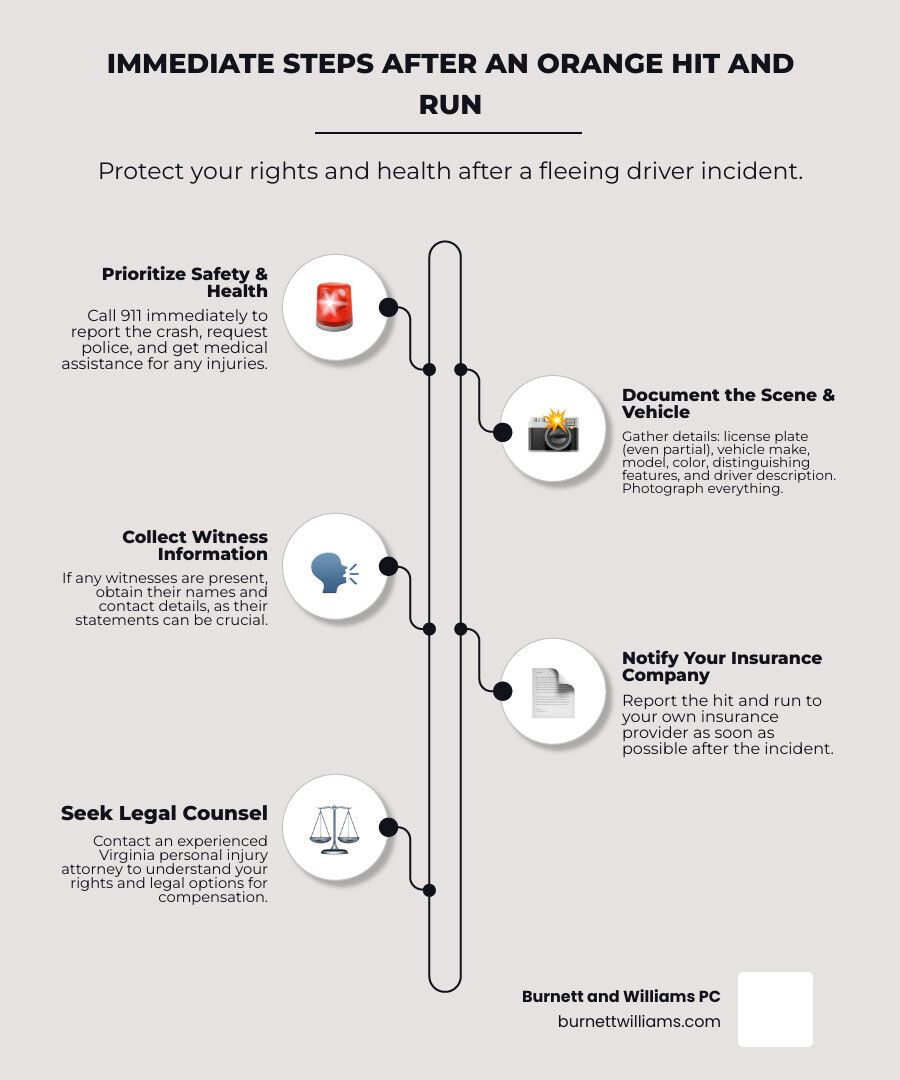
What to do immediately after a hit and run in Orange:
- Call 911: Report the crash to police and request medical assistance
- Stay safe: Move to a safe location if you can, but don’t leave the scene
- Gather evidence: Write down everything you remember about the vehicle and driver
- Get medical care: Even if injuries seem minor, see a doctor immediately
- Contact your insurance: Report the incident to your own insurer
- Speak with a Virginia attorney: Understand your legal options for compensation
The aftermath of a hit and run feels overwhelming. You didn’t ask for this. You may be in pain, worried about bills, and unsure where to turn. Taking the right steps now protects both your health and your legal rights.
Simple Orange hit and run glossary:
Understanding Virginia’s Hit and Run Laws

When someone hits your car and drives away, they’ve just committed a crime under Virginia law. An Orange hit and run isn’t just a frustrating inconvenience. It’s a serious criminal offense with real consequences for the driver who fled.
Virginia takes these cases seriously because leaving the scene of a crash puts everyone at risk. An injured person might not get the help they need, and victims are left with damage and injuries. Drivers flee for many reasons, like panic or lack of insurance. Fleeing transforms an accident into a criminal matter.
What Constitutes a Hit and Run in Virginia?
Virginia law is clear about what drivers must do after any accident. You must stop at the scene or as close to it as safely possible. You can’t just pull over for a minute and then leave.
Once you’ve stopped, you need to provide your information to everyone involved. That means your name, address, driver’s license number, and vehicle registration details. Rendering aid is also required. If someone is hurt, you need to help them get medical attention, which usually means calling 911.
These duties apply whether you’ve just sideswiped another car on Route 15 or caused a serious collision on Main Street in Orange. Even if you bump a parked car and can’t find the owner, you’re required to leave a note with your contact information. Walking away without doing so is still a hit and run.
Penalties for Fleeing the Scene
The penalties for leaving the scene depend on what happened in the crash itself.
If the accident only caused property damage, fleeing is a serious misdemeanor, carrying potential jail time, significant fines, and a license suspension.
If anyone was injured or killed, the charge becomes a felony, with penalties including potential prison time and a mandatory license revocation.
These penalties show how seriously Virginia treats these cases. For victims, it reinforces why reporting the incident to the Orange Police Department is so important to help authorities find the driver who left you to deal with the aftermath.
Immediate Steps to Take After an Orange Hit and Run
The moments after an Orange hit and run are shocking and confusing. Your heart is racing as you try to process what just happened. Your safety comes first. If your vehicle is in a dangerous spot, move it to the shoulder if you can do so safely and turn on your hazard lights. If you’re injured or your car won’t move, stay put and wait for help.
Now call 911. Tell the dispatcher you’ve been in a hit and run and need police and medical assistance. Even if you feel okay, get checked out by paramedics. Adrenaline can mask pain, and some injuries like whiplash or concussions don’t show up immediately. Getting medical attention creates a record linking your injuries to the crash.
Do not chase the driver who hit you. It’s dangerous and won’t help your case. Your job is to stay safe and gather information.
What Information Should I Try to Collect?
The details you remember can make or break the investigation. While everything is fresh, focus on gathering as much information as you safely can.
Try to get the license plate number, even a partial one. Write it down immediately. Note the vehicle’s make, model, color, and any distinguishing features like dents, bumper stickers, or a bike rack.
If you saw the driver, note their approximate age, gender, and what they were wearing. Note the direction they fled to help police check traffic cameras. Record the exact time and location of the crash, using cross-streets or landmarks.
If there were witnesses, get their names and phone numbers. Their account can be very helpful. Use your phone to photograph vehicle damage, the scene, any debris, and your injuries. Also, look for nearby security cameras on businesses that may have recorded the incident.
Reporting the Orange Hit and Run to Authorities
When police arrive, give a statement for the official report. This report is the foundation for your criminal and insurance case. You are also required to file a report with the DMV if the crash meets certain damage or injury thresholds. The police can guide you on this.
Report the hit and run to your own insurance company as soon as possible. Your uninsured motorist coverage may be key to your compensation if the at-fault driver isn’t found or doesn’t have insurance.
Seeking Compensation: Your Legal Options in Virginia
After an Orange hit and run, you’re facing more than just shock. Medical bills start arriving, your car needs repairs, and you’ve missed work. The person who caused all this drove away, but that doesn’t mean you’re without options.
Virginia law recognizes that hit and run victims deserve a path to financial recovery. You may be able to recover compensation for your medical expenses, lost wages, pain and suffering, and property damage.

The Role of Uninsured Motorist Coverage in an Orange Hit and Run
Your own auto insurance is often your best source of recovery. Virginia policies include Uninsured Motorist (UM) coverage, designed for cases where the at-fault driver is uninsured or, as in a hit and run, cannot be identified.
Your UM coverage acts as a substitute for the fleeing driver’s insurance. It can pay for your medical bills, lost income, pain and suffering, and vehicle repairs, up to your policy limits. While it may feel strange to file a claim with your own insurer for another driver’s mistake, this is exactly what UM coverage is for.
However, even your own insurer may try to minimize your claim. They might question your injuries or offer a low settlement. Having an advocate who understands these claims is crucial.
Virginia’s Contributory Negligence Rule
Virginia follows a strict legal standard when it comes to recovering damages after an accident. It’s called contributory negligence, and it can be a harsh reality for injury victims.
This rule means that if you are found to be even one percent at fault for the crash, you are barred from recovering any compensation. In a hit and run case, you must prove the fleeing driver was 100 percent responsible.
This makes the evidence you collect at the scene vital. Insurance adjusters may try to argue you were distracted or otherwise partially at fault to deny your claim. An experienced attorney knows how to build a case to counter these arguments and prove the other driver’s full responsibility.
For a quick general background on the concept, see contributory negligence.
The Legal Process and Why You Need an Attorney
After an Orange hit and run, you have a limited time to act. Virginia’s statute of limitations typically gives you two years to file a personal injury lawsuit, and this deadline passes quickly while you are recovering.
Building a strong case requires a thorough investigation, including gathering police reports, witness statements, medical records, and any available surveillance footage. You will also face insurance adjusters who are trained to minimize payouts. They may use Virginia’s contributory negligence rule against you, arguing you share some fault to avoid paying your claim.
Proving your damages is also complex, involving not just current bills but future medical needs, lost earning capacity, and pain and suffering. If your claim is denied, a lawsuit may be necessary. Navigating the court system requires understanding local procedures, filing deadlines, discovery rules, and trial preparation.
How a Lawyer Can Help Your Case
You shouldn’t have to face this alone. When you work with our team at Burnett & Williams PC, we handle the legal complexities while you focus on healing.
Investigating the crash thoroughly: We investigate thoroughly, interviewing witnesses, finding surveillance footage, and potentially working with experts to build your case.
Identifying the at-fault driver: Our investigation can sometimes help identify the fleeing driver, which opens up additional avenues for compensation beyond your own policy.
Negotiating with insurance companies: We handle all communications with insurance adjusters. We know their tactics and fight back against low-ball offers and unfair denials to protect your interests.
Maximizing your compensation: We work to maximize your compensation by documenting the full impact of the crash on your life, including future medical needs, lost wages, and pain and suffering.
Protecting your rights: Throughout the process, we protect your rights by managing deadlines and procedures, allowing you to focus on healing while we handle the legal complexities.
For a deeper look at how we approach injury claims in Orange County, visit our Orange Virginia Injury Guide.
Conclusion
An Orange hit and run leaves you with injuries, a damaged vehicle, and many questions. The person responsible drove away, but you are not without options.
Remember to prioritize your safety, get medical care, report the crash to the police, and gather all possible evidence. Your Uninsured Motorist coverage is a key path to compensation, but Virginia’s contributory negligence rule makes a strong case essential.
You didn’t ask for this accident. You shouldn’t have to face the aftermath alone.
Our team at Burnett & Williams PC understands the challenges hit and run victims face. We investigate your crash, advocate for your rights against insurance companies, and pursue the compensation you need to move forward.
Contact our Orange office for a free consultation to understand the path forward. You don’t have to steer this alone.