
Immediate Steps and Evidence Gathering After a Loudoun County Drunk Driving Crash
When an intoxicated driver causes a collision on Route 7 or through downtown Leesburg, the moments right after can feel overwhelming. Securing key evidence early is essential to protect your health, satisfy emergency needs, and support your eventual financial recovery. Recovering from a sudden crash involves navigating medical bills, vehicle repairs, and complex legal standards all while trying to heal.
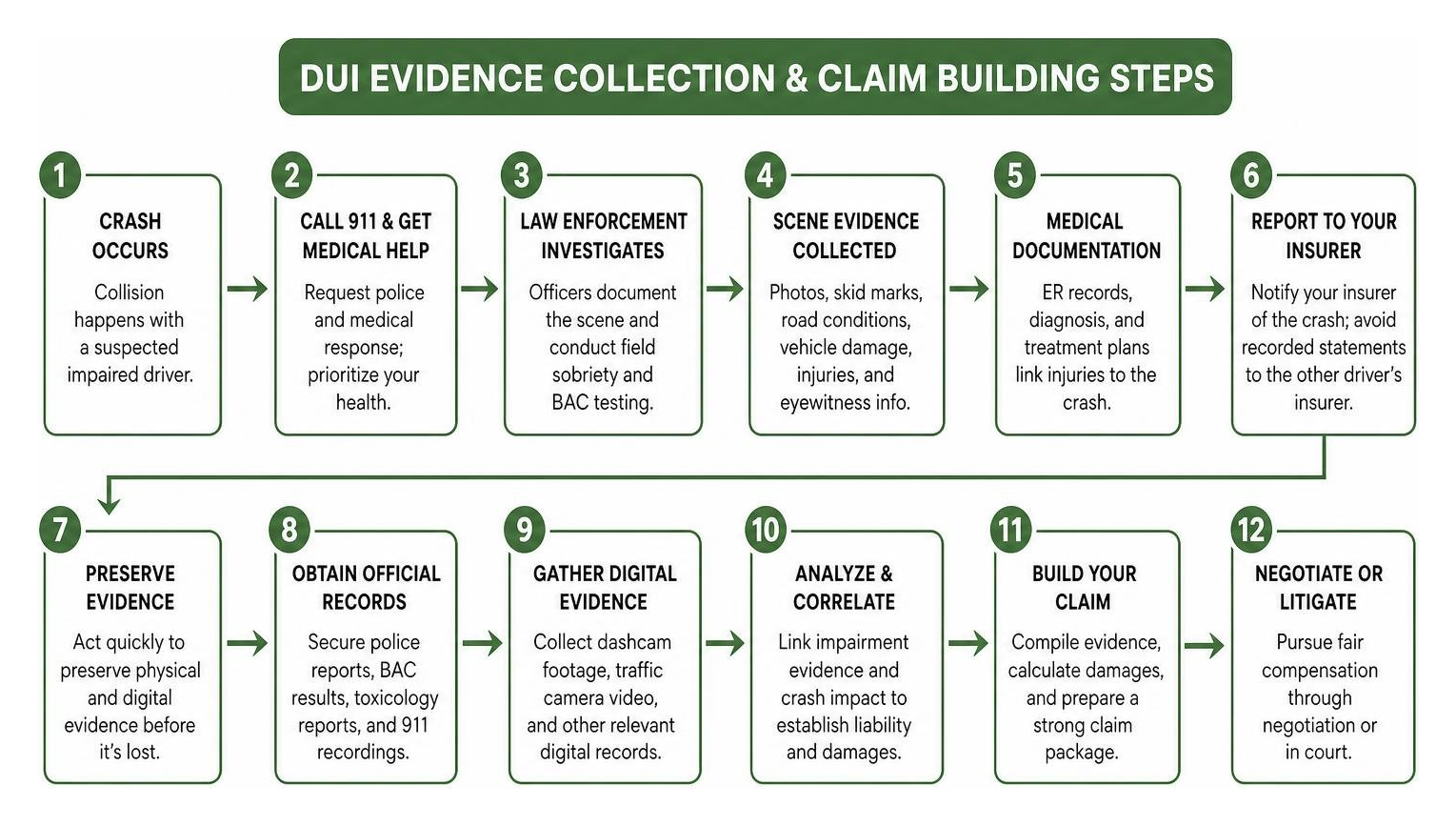
- Prioritize Medical Attention: Call 911 immediately so law enforcement and medical teams respond. Even if you feel fine, adrenaline can mask serious internal injuries, concussion symptoms, or spinal trauma.
- Ensure Law Enforcement Documents Impairment: Tell responding Loudoun County Sheriff’s deputies or Leesburg Police officers if you suspect the driver was drinking or under the influence of drugs. Officers can conduct preliminary field sobriety evaluations, record physical observations, and administer chemical breath or blood tests on-site.
- Gather Evidence at the Scene: If you are physically able and in a safe area, take comprehensive pictures of vehicle positions, skid marks, road conditions, traffic signals, and any visible physical injuries. Exchange driver and insurance information, and collect contact details from eyewitnesses.
- Follow Up on Medical Care: Detailed emergency room records, diagnostic scans, and follow-up treatment plans establish a direct, undeniable link between the drunk driver’s reckless actions and your physical injuries.
- Report to Your Insurer: Contact your insurance carrier to notify them of a Leesburg car crash, but avoid giving recorded statements to the drunk driver’s insurance adjuster before seeking proper legal guidance.
Working with an experienced Loudoun accident lawyer helps protect crucial physical and digital evidence before it is overwritten, lost, or destroyed.
Why You Need a Leesburg DUI Accident Injury Lawyer to Build Your Claim
Establishing full liability in a drunk driving claim requires much more than just showing that a crash occurred. Our legal team acts quickly to secure official blood alcohol concentration (BAC) testing logs, police toxicology reports, 911 audio recordings, physical crash debris analysis, and local dashcam or surveillance video footage.
Virginia sets strict legal thresholds for impairment. The statutory legal blood alcohol concentration limit is 0.08% for adult drivers 21 and older, while drivers under 21 face a strict zero-tolerance threshold of 0.02%. According to safety research from the National Highway Traffic Safety Administration, alcohol impairment dramatically impairs driver reaction times, depth perception, and spatial awareness well before a driver reaches high blood alcohol levels.
Additionally, high BAC levels, such as 0.15% or 0.20%, carry heavier criminal consequences that can strongly support a personal injury claim. Even if a driver’s BAC falls under statutory limits, proving actual impairment through arresting officer testimony and witness observations remains vital. Because DUI laws get tougher this month, having knowledgeable legal representation ensures every piece of chemical analysis and physical evidence is compiled effectively to hold the at-fault driver fully accountable.
Understanding Virginia DUI Laws and How They Impact Civil Personal Injury Claims

Many crash victims assume that if the police arrest a drunk driver, the driver’s insurance company will automatically pay for all resulting injuries and damages. However, criminal proceedings and civil injury claims serve two entirely separate legal functions in Loudoun County courts and require completely different legal strategies.
In a criminal proceeding, the Commonwealth of Virginia prosecutes the driver to punish unlawful behavior and protect public safety. The prosecution must prove guilt beyond a reasonable doubt, which is the highest legal standard. In contrast, your civil injury lawsuit seeks direct financial compensation for the specific physical, emotional, and economic losses you suffered. In civil court, the standard of proof is a “preponderance of the evidence,” meaning we must demonstrate that it is more likely than not that the driver’s actions caused your harm. Driving guidelines and enforcement updates from the Virginia Department of Motor Vehicles demonstrate how seriously alcohol offenses are treated across the state.
Because civil courts require a lower burden of proof, an injured victim can still win a civil financial recovery even if the driver is not convicted of a criminal offense or if criminal charges are reduced or dismissed. Understanding the new drunk driving in Virginia framework allows us to leverage evidence from criminal arrests directly into winning civil court strategies.
Navigating Contributory Negligence with a Leesburg DUI Accident Injury Lawyer
Virginia operates under a strict pure contributory negligence legal standard. Under this rule, if an injured party contributed even one percent to the cause of an accident, they are generally barred from recovering any financial compensation from the other driver, regardless of how severely they were hurt.
Insurance companies frequently use this strict rule to avoid paying full claims, arguing that an injured driver was speeding, failed to signal early enough, or hesitated before impact. In cases involving drunk drivers, defense adjusters may still aggressively attempt to shift partial blame onto you to escape paying compensation.
We thoroughly investigate every crash scene to counter these defense tactics. By potentially working with accident reconstruction specialists, evaluating physical skid marks, and gathering clear eyewitness accounts, we demonstrate that the impaired driver’s reckless actions were the sole proximate cause of the crash. To learn more about how we counter defense strategies, review our comprehensive Leesburg personal injury attorney guide.
How a Leesburg DUI Accident Injury Lawyer Advocates for Full Financial Compensation
Drunk driving collisions often cause devastating injuries due to high impact speeds, delayed braking, and severe collision dynamics. We advocate to secure comprehensive compensation that addresses both your immediate financial burdens and potential long-term medical and personal recovery needs.
Compensatory damages available in Virginia injury cases include:
- Medical Expenses: Emergency transport, surgical fees, hospital stays, rehabilitation, physical therapy, and prescription medication.
- Lost Income and Earning Capacity: Full compensation for time missed at work during recovery and reduced future earning potential due to lasting physical disability or impairment.
- Pain and Suffering: Financial recovery for physical pain, emotional trauma, post-traumatic anxiety, sleeplessness, and diminished quality of life.
- Property Damage: Full repair or replacement costs for your motor vehicle and personal belongings damaged in the crash.
For an in-depth look at valuation methods and recovery strategies for crash claims, explore our Leesburg car accident attorney complete guide.
Seeking Punitive Damages Against Intoxicated Drivers in Virginia
In addition to standard compensatory damages, Virginia law allows victims of drunk driving crashes to pursue punitive damages. Punitive damages are intended to punish an impaired driver for exceptionally bad or egregious conduct and deter others in the community from engaging in similar dangerous actions.
To qualify for punitive damages without having to prove actual legal malice, state law provides specific objective criteria:
- The driver must have a blood alcohol concentration of 0.15% or higher at the time of the crash (or unlawfully refuse a chemical breath or blood test).
- The driver knew or should have known that their physical or mental ability to operate a motor vehicle was significantly impaired before getting behind the wheel.
- The driver’s intoxication was a direct cause of the collision and resulting physical injuries.
When an intoxicated driver chooses to drive with an elevated BAC, their deliberate disregard for human life justifies seeking additional punitive financial awards. Our firm gathers chemical test results and driver history to pursue maximum recovery under our guide on drunk driving punitive damages in Virginia.
Virginia Statute of Limitations and Insurance Coverage Issues
Time is a critical factor following any serious traffic accident. In Virginia, personal injury and wrongful death lawsuits are governed by a strict two-year statute of limitations. This means you generally have exactly two years from the date of the collision, or from the date of a loved one’s passing, to file a lawsuit in court. If you miss this statutory deadline, you forfeit your legal right to seek financial compensation permanently. If an accident or wrongful death occurs outside of Virginia, our firm coordinates directly with trusted co-counsel in that specific jurisdiction to ensure your legal rights remain fully protected.
Navigating insurance policies presents another complex challenge after a crash involving an impaired driver. If a drunk driver is uninsured or carries insufficient liability limits to cover your extensive medical bills and lost wages, you may need to rely on your own policy’s Uninsured/Underinsured Motorist (UM/UIM) coverage. In complex cases involving commercial vehicles or multi-vehicle crashes, additional insurance layers may apply; review our Leesburg truck accident lawyer guide to understand complex policy structures.
Frequently Asked Questions About Leesburg DUI Accident Injury Cases
Can I still recover compensation if the drunk driver was acquitted in criminal court?
Yes. Criminal courts require proof “beyond a reasonable doubt,” whereas civil claims use the lower “preponderance of the evidence” standard. A criminal acquittal or reduced charge does not bar you from pursuing or winning a civil injury claim based on driver negligence.
How long do I have to file a DUI accident lawsuit in Leesburg, Virginia?
Virginia imposes a strict two-year statute of limitations for personal injury and wrongful death lawsuits starting from the date of the crash or loss. Contacting an attorney well before this deadline ensures ample time to preserve evidence and negotiate with insurance carriers.
How does Virginia’s implied consent law affect my personal injury claim?
Under Virginia’s implied consent rule, anyone operating a vehicle consents to chemical breath or blood testing if arrested for suspected DUI. If a driver unlawfully refuses testing, that refusal can lead to administrative penalties and can often be introduced in civil proceedings to demonstrate conscious disregard for public safety.
Conclusion
Recovering after a drunk driving crash requires clear answers and advocacy. At Burnett & Williams PC, we bring decades of experience advocating for injured individuals across Loudoun County, Greater Richmond, Midlothian, Petersburg, and Central Virginia. We prioritize responsive, caring service and involve you directly in every key decision.
If you or a family member was hurt by an impaired driver, contact our team today through our Personal Injury Lawyer Leesburg office or take a virtual Leesburg Office Tour to see how we can assist you.