
When Tragedy Strikes: Understanding Your Legal Rights After Loss
A wrongful death lawsuit is a civil legal action that allows surviving family members to seek compensation when their loved one dies due to another party’s negligence, recklessness, or intentional wrongdoing. These lawsuits serve two critical purposes: holding the responsible party accountable and providing financial support to those left behind.
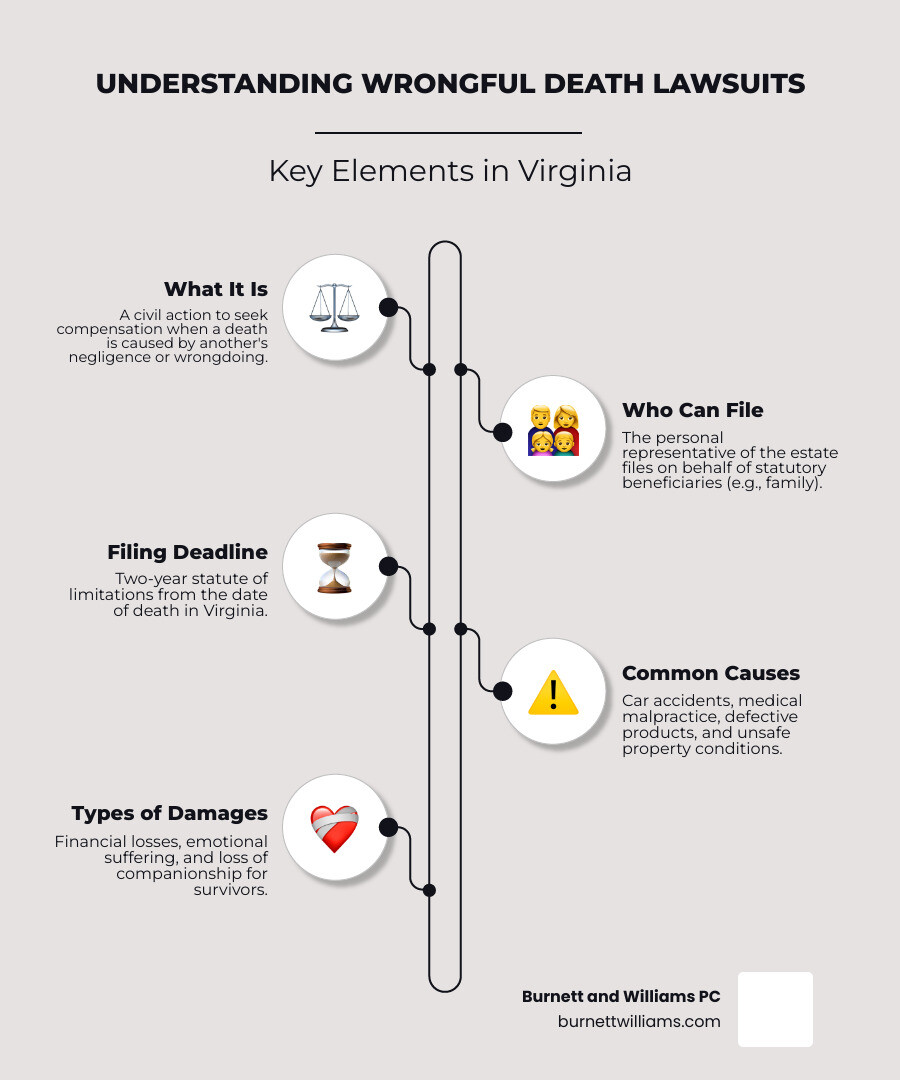
Key Elements of a Wrongful Death Lawsuit:
- Who can file: Personal representative of the estate on behalf of statutory beneficiaries
- Time limit: Two years from the date of death in Virginia
- Purpose: Compensate survivors for their losses, not the deceased’s suffering
- Common causes: Car accidents, medical malpractice, defective products, unsafe conditions
- Damages: Financial losses, emotional suffering, loss of companionship and guidance
Losing someone you love is devastating enough. When that loss happens because someone else failed to act responsibly, the pain cuts even deeper. Whether it’s a fatal accident on I-81 in Winchester, medical negligence at a Virginia hospital, or a defective product that should never have reached store shelves, these preventable tragedies leave families struggling with both grief and financial uncertainty.
Virginia law recognizes that while no amount of money can bring back your loved one, compensation can help ease the financial burden and provide a measure of justice. Understanding your rights under Virginia’s wrongful death statutes is the first step toward healing and securing your family’s future.
What Constitutes a Wrongful Death Claim in Virginia?
When someone dies because of another person’s wrongful act, neglect, or default, Virginia law allows their family to seek justice through a wrongful death lawsuit. Think of it this way: if your loved one would have been able to file a personal injury claim had they survived their injuries, then you may be able to pursue a wrongful death case on their behalf.
A wrongful death lawsuit is completely separate from any criminal charges. While the criminal justice system focuses on punishing the wrongdoer, your civil case aims to provide financial compensation for the tremendous losses your family has suffered.
Proving your case requires establishing four key elements. First, you must show the responsible party owed a duty of care to your loved one. A driver has a duty to operate their vehicle safely on I-81. A doctor has a duty to provide competent medical care. A property owner has a duty to maintain safe conditions.
Next, you need to prove there was a breach of duty. Maybe the driver was texting instead of watching the road. Perhaps the surgeon made a preventable error during a routine procedure. Or a manufacturer released a dangerous product without proper warnings.
Causation forms the third element. The breach of duty must have directly caused your loved one’s death. There needs to be a clear connection between the negligent act and the tragic outcome that brought your family to this difficult moment.
Finally, damages must be proven. Your family must have suffered actual losses as a result of the death, whether financial, emotional, or both.
Virginia’s contributory negligence rule presents a significant challenge. If the deceased is found to have contributed to their own death in any way, even just 1%, it could potentially prevent your family from recovering any compensation whatsoever. This harsh rule makes skilled legal investigation and representation absolutely critical in Virginia wrongful death cases.
Common causes of wrongful death across Virginia include devastating car accidents on busy highways like I-81 through Winchester or the Capital Beltway around Northern Virginia, a tragic reality confirmed by data from organizations like the National Highway Traffic Safety Administration (NHTSA). Trucking accidents on I-81 can be particularly catastrophic due to the sheer size and weight of commercial vehicles. Medical malpractice cases arise when healthcare providers make preventable errors that cost lives. Defective products sometimes make it to store shelves with dangerous flaws that prove fatal. Unsafe property conditions can lead to tragic accidents when property owners fail to maintain safe premises.
For more comprehensive information about these types of cases, you can explore our detailed resources on Wrongful Death Cases.
Who is Eligible to File a Claim?
Virginia law is very specific about who can bring a wrongful death lawsuit. You can’t simply file a case because you’re grieving or angry about what happened. The lawsuit must be filed by the Personal Representative of your loved one’s estate.
The Personal Representative is typically the Executor named in your loved one’s will, or if there’s no will, an Administrator appointed by a Virginia court. This person acts as the legal voice for the deceased, filing the lawsuit on behalf of all eligible family members.
The law prioritizes certain family members as statutory beneficiaries who can receive compensation. Surviving spouses and children including adopted children and stepchildren come first. If your loved one wasn’t married and had no children, then parents and siblings are next in line. When none of these family members exist, dependent relatives who lived with the deceased and relied on them financially may be eligible.
This system ensures that those who were closest to the deceased and most affected by the loss have the legal right to seek justice and compensation.
What is the Deadline for Filing in Virginia?
Time is absolutely critical when it comes to filing a wrongful death lawsuit in Virginia. You have exactly two years from the date of death to file your case in court. Miss this deadline, and you could lose your right to seek compensation forever, no matter how strong your case might be.
The importance of acting quickly cannot be overstated. While you’re grieving and trying to put your life back together, legal deadlines don’t pause. Evidence can disappear, witnesses’ memories fade, and crucial documentation can be lost or destroyed.
Missing these deadlines can completely bar your claim, even if you later file your lawsuit within the two-year window. That’s why seeking legal guidance immediately after a wrongful death is so important for protecting your family’s rights.
Understanding the Virginia Wrongful Death Lawsuit Process
When you’re facing the loss of a loved one due to someone else’s negligence, understanding the legal process ahead can feel overwhelming. We’ve walked alongside countless Virginia families through this difficult journey, and we want you to know what to expect every step of the way.
.png?alt=media&token=1f0fbdcb-62fb-486b-9480-ef4a00569245 "Exterior of the Fairfax County Circuit Court - Wrongful death lawsuit")
Your wrongful death lawsuit journey begins with an initial consultation where we sit down together to understand what happened to your loved one. This isn’t just about legal facts. We listen to your story, learn about the person you lost, and help you understand whether Virginia law supports a claim in your situation.
Once we decide to move forward together, we begin the crucial work of investigation and evidence gathering. Think of this as building the foundation of your case. We collect police reports if the death involved an accident on I-95 or local Virginia roads. For cases involving medical malpractice at Virginia hospitals, we gather medical records and autopsy reports. We also interview witnesses who saw what happened and work with expert witnesses like accident reconstruction specialists or medical professionals who can explain complex details to a jury.
After we’ve gathered strong evidence, we file the complaint in the appropriate Virginia Circuit Court. This might be the Winchester Circuit Court, Fairfax County Circuit Court, or whichever court has jurisdiction over your case. This legal document formally begins your lawsuit and explains to the court what happened and the compensation your family is seeking.
Both sides share information about the case. We might send written questions to the other party, request important documents, and conduct depositions. These are formal interviews where people involved in the case answer questions under oath, but outside the courtroom.
Throughout this entire process, we’re often engaged in settlement negotiations. Most Virginia wrongful death cases actually resolve through settlement rather than going to trial. Insurance companies usually handle these negotiations, and they often try to settle quickly for less than your case is worth. We’ve seen this countless times, and we know how to push back against lowball offers to get you fair compensation.
If we can’t reach a fair settlement, your case may go to trial. While this process can feel intimidating, we’ll be right there with you, presenting your case to a Virginia jury and advocating for your family every step of the way.
The Role of a Lawyer
Losing someone you love is hard enough without having to become a legal expert overnight. That’s where we come in. Our job is to handle the legal complexities so you can focus on grieving and healing with your family.
We start by navigating the legal complexities of Virginia law. Virginia has its own specific rules and procedures that must be followed exactly, and we know these inside and out.
Protecting your rights means we become your shield against aggressive insurance adjusters who might contact you directly. We handle all communications with the other side, so you don’t have to deal with difficult phone calls or confusing paperwork during this painful time.
One of our most important jobs is calculating damages accurately. This isn’t just about adding up medical bills and funeral costs. We work with economists and other experts to determine the full value of what your family has lost, including future income, companionship, and guidance your loved one would have provided.
When it comes to negotiating with insurers, we bring years of experience dealing with insurance companies who try to minimize payouts. We know their tactics, and we know how to counter them effectively.
If your case goes to court, we’re fully prepared for representing you in court. We’ll present your story clearly and compellingly, making sure the jury understands not just what happened, but who your loved one was and what their loss means to your family.
For more detailed information about how we handle these sensitive cases, you can learn more about pursuing a Wrongful Death Claim.
What Types of Damages Can Be Recovered?
When someone you love dies because of another person’s carelessness or negligence, the impact ripples through every aspect of your life. Beyond the crushing grief, families often face unexpected financial hardships and the loss of guidance, support, and companionship that can never truly be replaced.

A wrongful death lawsuit in Virginia recognizes that while no amount of money can bring back your loved one, compensation can help address the very real financial and emotional losses your family faces. The purpose isn’t to punish the wrongdoer, but rather to provide financial stability and a sense of justice during an incredibly difficult time.
Virginia law allows families to recover compensation for both the tangible financial impacts and the profound emotional suffering that follows such a tragic loss. Our team works diligently to ensure that every aspect of your family’s loss is carefully evaluated and included in your claim. For a comprehensive look at what compensation might be available in your specific situation, we invite you to explore our detailed guide on Understanding Compensation Wrongful Death Claims.
A Closer Look at Recoverable Damages
The Commonwealth of Virginia recognizes several categories of damages that surviving family members may recover in a wrongful death claim. Each family’s situation is unique, and the compensation available depends on the specific circumstances of the loss and the relationship between the deceased and the survivors.
Sorrow and mental anguish compensation acknowledges the intense grief and emotional pain that survivors experience. This isn’t just about the immediate shock of loss, but the ongoing emotional suffering that comes with losing someone who was central to your life. Virginia courts understand that this type of pain, while impossible to quantify precisely, deserves recognition and compensation.
Loss of companionship, comfort, and guidance addresses the intangible but invaluable contributions your loved one made to your daily life. This includes the loss of their love, advice, emotional support, and the unique role they played in your family. Whether it’s a spouse who provided emotional stability, a parent who offered wisdom and guidance, or a child whose presence brought joy and hope for the future, these losses are real and compensable under Virginia law.
Lost income and financial support covers the money your loved one would have earned and contributed to the family over their expected lifetime. This includes not just their current salary, but also anticipated raises, bonuses, benefits, and other financial contributions. Our team works with economic experts to calculate these losses accurately, considering factors like career trajectory, age, health, and earning potential.
Loss of services and protection compensates for the valuable household services and care your loved one provided. This might include childcare, home maintenance, financial management, or simply the security that came from having them in your life. For instance, if your spouse handled all the household repairs or managed the family finances, the cost of replacing these services can add up significantly over time.
Medical bills incurred before death can be recovered as part of your wrongful death claim. If your loved one received medical treatment for injuries from the incident that ultimately caused their death, these expenses are typically recoverable, helping to ease the financial burden of what may have been extensive medical care.
Funeral and burial expenses include the reasonable costs associated with laying your loved one to rest. This covers funeral services, burial or cremation costs, and related expenses. While these costs can’t compare to your emotional loss, they represent a very real financial burden that shouldn’t fall entirely on grieving families.
In cases involving particularly egregious conduct, Virginia law also allows for punitive damages. These are awarded when the defendant’s behavior was especially reckless, willful, or showed a complete disregard for human life. Unlike other damages that compensate for losses, punitive damages are specifically designed to punish the wrongdoer and send a message that such conduct won’t be tolerated. However, these damages are only available in the most severe cases where the defendant’s actions went far beyond ordinary negligence.
Every family’s situation is different, and the full value of your claim depends on many factors specific to your circumstances. We take the time to understand not only the financial impact of your loss, but also the unique role your loved one played in your family’s life, ensuring that every aspect of your loss is considered when seeking compensation.
Frequently Asked Questions about Virginia Wrongful Death Lawsuits
When you’re dealing with the loss of a loved one, it’s natural to have questions about your legal options. We’ve found that families often have similar concerns when considering a wrongful death lawsuit in Virginia. Let us walk you through some of the most important questions we hear.
How is a wrongful death lawsuit different from a survival action in Virginia?
This is one of the most common questions we encounter, and it’s important to understand because Virginia allows both types of claims. Think of it this way: they’re like two different lenses looking at the same tragic event.
A wrongful death claim focuses entirely on what the surviving family members have lost. When we file this type of lawsuit, we’re seeking compensation for your losses as the survivors. This includes the sorrow and mental anguish you’re experiencing, the loss of your loved one’s companionship and guidance, and the financial support they would have provided throughout their lifetime.
A survival action takes a different approach. This claim compensates the deceased person’s estate for what they experienced and lost before passing away. If your loved one suffered pain before death, incurred medical bills, or lost wages during their final illness or injury, a survival action can recover those damages.
Here’s what makes this particularly important: these are two separate but related claims that can often be pursued together. Many families benefit from filing both types of lawsuits because they provide more comprehensive compensation for all the losses stemming from the same incident.
How much is a wrongful death lawsuit worth in Virginia?
We understand this question weighs heavily on families’ minds, especially when you’re facing unexpected expenses and lost income. The honest answer is that there’s no set amount for wrongful death settlements or verdicts in Virginia. Every case tells a unique story, and the compensation reflects that individuality.
Several case-specific factors influence the value of your claim. The severity of negligence involved plays a significant role. Was this a momentary lapse in judgment, or was it reckless behavior that showed complete disregard for safety? The more egregious the conduct, the higher the potential compensation.
Your financial losses form another crucial piece of the puzzle. We look at your loved one’s age, career trajectory, education level, and earning potential. A young professional with decades of earning capacity ahead represents different financial losses than someone nearing retirement.
The strength of evidence for emotional loss also matters greatly. How close was your relationship? Were you financially dependent on the deceased? Did they provide guidance and support that can’t be replaced? These human elements, while difficult to quantify, are very real losses that Virginia law recognizes.
The age and health of the deceased factor into life expectancy calculations, while the number of beneficiaries affects how damages might be distributed among surviving family members.
We work with economic experts and other professionals to carefully evaluate all these factors and build a comprehensive picture of your family’s losses.
What happens if the deceased was partially at fault for the accident?
This question touches on one of Virginia’s harshest legal rules, and it’s something every family needs to understand early in the process. Virginia follows a rule called contributory negligence.
Under Virginia’s rule, if the deceased is found even 1% at fault for the accident that caused their death, the family may be completely barred from recovery. This isn’t a reduction in damages based on the percentage of fault. It’s an all-or-nothing rule that can eliminate your right to compensation entirely.
This might seem unfair, and many people are shocked when they first learn about it. For example, if your loved one was killed in a car accident and the jury finds that the other driver was 90% at fault but your family member was 10% at fault for perhaps exceeding the speed limit slightly, you could receive nothing.
There are some narrow exceptions to the rule, such as cases involving the last clear chance doctrine or certain situations with children, but these are limited circumstances that require careful legal analysis.
This harsh rule makes skilled legal analysis absolutely critical in Virginia wrongful death cases. We must thoroughly investigate every aspect of the incident to build the strongest possible case that the defendant bears complete responsibility. This often involves accident reconstruction experts, witness testimony, and detailed examination of all the evidence.
The contributory negligence rule is exactly why you need experienced legal representation from the very beginning. What might seem like minor details could become crucial factors in protecting your family’s right to compensation.
Conclusion: Seeking Justice for Your Loved One
Losing a loved one is an unimaginable tragedy, especially when it results from someone else’s negligence or wrongdoing. While no legal action can ever truly fill the void left by their absence, a wrongful death lawsuit in Virginia can offer a vital path toward accountability and financial stability for the survivors. It provides a means to secure compensation for both the tangible economic losses and the profound emotional suffering your family endures.

At Burnett & Williams, we believe in responsive, caring client service and involving you in every decision. We understand the immense grief and stress you are facing, and we are here to provide compassionate guidance through every step of this challenging legal journey. The importance of seeking timely legal advice cannot be overstated, particularly given Virginia’s strict statutes of limitations and contributory negligence laws. Let us help you navigate these complexities and pursue a fair outcome for your loved one.
If you have lost a family member due to another’s negligence in Leesburg, Midlothian, Orange, Winchester, Culpeper, Hopewell, Richmond, or anywhere across Northern Virginia, Central Virginia, the Greater Richmond area, or the Tri-Cities area including Chesterfield and Petersburg, we are here to help. Please do not hesitate to reach out. We offer initial consultations to discuss your specific situation and explore your legal options.
Contact a Virginia personal injury attorney to discuss your case today.