
Why Preparing for Your First Medical Malpractice Consultation Matters
How to prepare for your first interview with a medical malpractice attorney starts with organizing your story and documents. This preparation helps an attorney give you a clear, honest assessment of your options under Virginia’s complex laws.
Quick Preparation Checklist:
- Gather medical records from providers.
- Create a timeline of your treatment and the problems that arose.
- Document your damages, including medical bills and lost income.
- Prepare questions about the attorney’s experience in Virginia.
- Note key deadlines, like Virginia’s two-year statute of limitations.
When you suspect a healthcare provider’s mistake caused you harm, the path forward can feel overwhelming. Medical malpractice cases in Virginia are complex, requiring proof that a provider violated the accepted standard of care and directly caused your injuries. Not every bad outcome qualifies.
This guide explains how to prepare for your initial consultation. The better prepared you are, the more productive your meeting will be, giving you a clearer understanding of your legal options.
First, Understand the Basics of a Virginia Malpractice Claim
Before your meeting, it helps to know what medical malpractice means under Virginia law. Many people assume any negative medical result is malpractice, but the legal standard is more specific. Understanding this distinction will lead to a more productive conversation with an attorney.
_compressed.png?alt=media&token=b1bc41cd-69b0-4756-9b39-5fab0ceede49 "gavel and stethoscope - how to prepare for first interview with medical malpractice attorney")
Medical malpractice occurs when a healthcare professional’s actions fall below the accepted standard of care, and that failure directly causes you harm. For example, a preventable surgical error at a Fairfax hospital that causes permanent nerve damage could be malpractice. However, an infection after a perfectly performed surgery might be an unavoidable complication, not negligence.
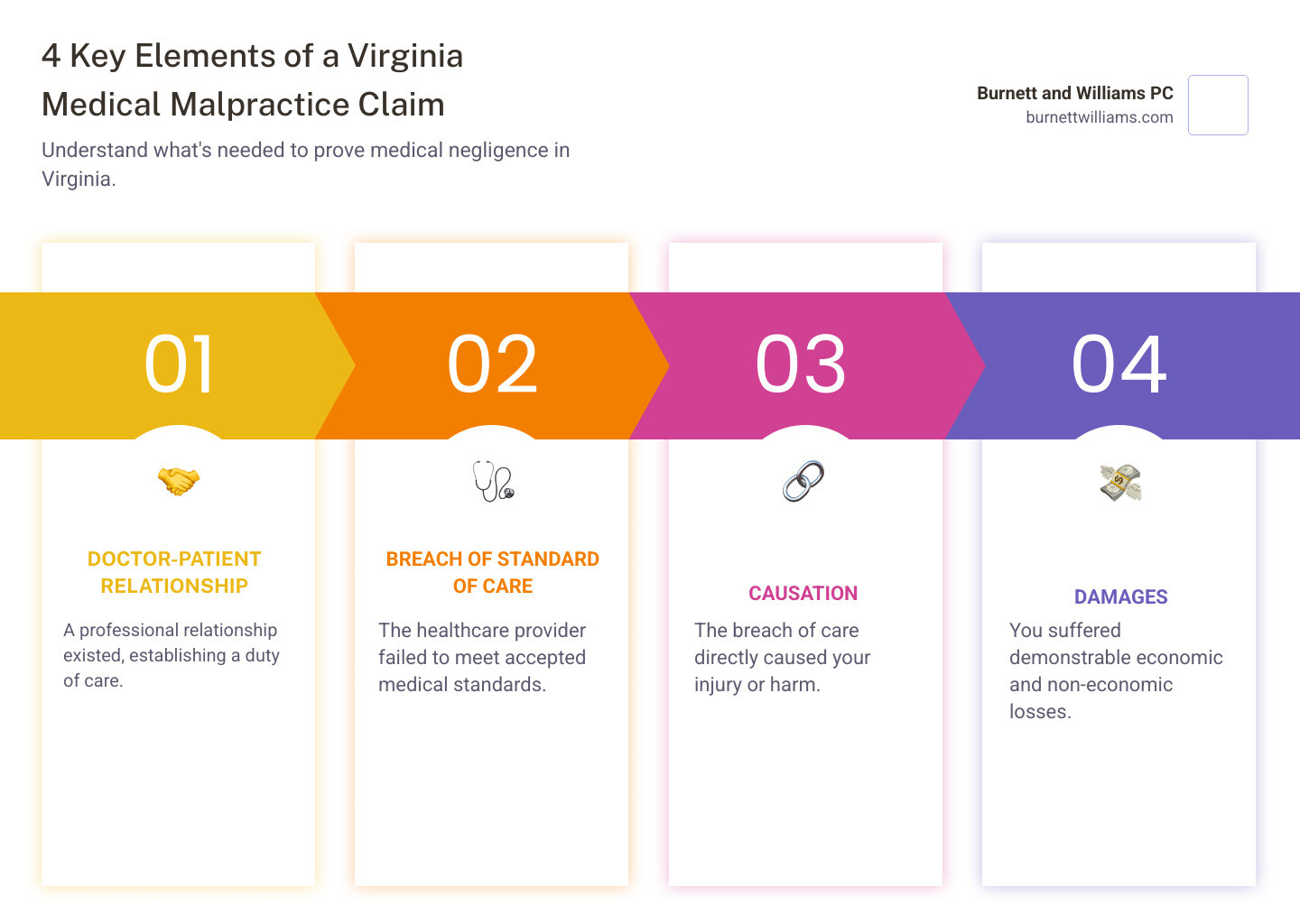
To have a valid claim in Virginia, you must prove four essential elements:
- Duty of Care: A professional relationship existed between you and the healthcare provider.
- Breach of Standard of Care: The provider failed to act as a reasonably competent professional in Virginia would have under similar circumstances. This usually requires testimony from a medical expert.
- Causation: The provider’s breach of care directly caused your injury.
- Damages: You suffered real, quantifiable harm, such as medical bills, lost wages, and pain and suffering.
Virginia also has a strict contributory negligence rule. If you are found even one percent at fault for your own injuries, you can be barred from recovering any compensation. This makes Virginia malpractice cases particularly challenging, as we explain in our guide to Understanding Medical Malpractice Laws in Virginia.
How to Prepare for Your First Interview with a Medical Malpractice Attorney
With a basic understanding of Virginia malpractice law, you can now focus on how to prepare for first interview with medical malpractice attorney. Your organization helps us accurately assess your case and gives you confidence in your choice of legal counsel.
Step 1: Gather Your Documents and Evidence
The more thorough you are with your documents, the better. Start by collecting these key items:
- Medical Records: Gather all records related to the incident, including notes, test results, and discharge summaries from providers.
- Bills and Receipts: Collect all medical bills, pharmacy receipts, and proof of any out-of-pocket expenses.
- Insurance Correspondence: Include any letters or emails from your health insurance company.
- Photos or Videos: If you have visual evidence of your injuries, bring it.
- Provider Information: Write down the names and contact details for all healthcare providers involved. You can often verify a provider’s credentials through the Virginia Board of Medicine.
- Communications: Save any emails or letters you exchanged with your doctors or their staff.
Step 2: Create a Detailed Timeline of Events
A clear timeline is invaluable for helping an attorney understand your story. Write down the sequence of events to ensure accuracy.

Start with when your treatment began and mark the date you believe the error occurred. Document all follow-up appointments, therapies, and important conversations with medical staff. Briefly note how the injuries have affected your daily life, work, and family. Even a rough timeline is a great starting point.
Step 3: Prepare Your Questions and Yourself
This meeting is a two-way interview. You are evaluating us just as we are evaluating your case. Come prepared with questions to get the information you need.
- What is your experience with medical malpractice cases in Virginia, especially ones like mine?
- Based on what you’ve heard, what are the strengths and weaknesses of my case?
- What is your track record with malpractice cases in Virginia courts?
- How do you find and work with medical experts?
- How are fees and case costs handled? Most Virginia firms work on a contingency fee, but it’s important to understand the details.
- What is your communication style, and how will I be updated on my case?
Clarifying your own goals is also important. Knowing what you hope to achieve helps us align our strategy with your expectations.
The Consultation: What to Expect and Key Questions to Ask
Your first meeting with a Virginia medical malpractice attorney is a confidential, no-obligation conversation to explore your options. You are not committing to a lawsuit by attending; you are simply gathering information to make an informed decision.

During the initial interview, we will first listen to your story in your own words. We will ask clarifying questions to understand the facts that are important under Virginia law. Next, we will review the documents you brought to get a clearer picture of the medical and legal issues.
Based on this information, we will give you our preliminary assessment of your case, including its strengths and potential challenges. We will be straightforward about whether we believe you have a viable claim. Finally, we will discuss potential next steps, which could involve further investigation or consulting with medical experts.
This meeting is your opportunity to interview us. Be sure to ask critical questions:
- Experience: Have you handled cases in Virginia courts, such as in Fairfax or Loudoun? What is your track record?
- Resources: What resources do you have for hiring qualified medical experts to support a case?
- Communication: How often will I hear from you, and who will be my primary point of contact?
- Costs: Can you explain the contingency fee agreement and any other potential litigation costs? We provide a breakdown in our article on the Cost of Medical Malpractice.
- Deadlines: What is the statute of limitations for my specific case?
- Risks: What are the risks involved, especially considering Virginia’s strict contributory negligence rule?
Navigating Virginia’s Specific Legal Landscape
Virginia’s medical malpractice laws have unique rules that can significantly affect your case. Understanding these ahead of time will help you ask better questions during your consultation.
Critical Deadlines: Virginia’s Statute of Limitations
One of the most important rules is Virginia’s statute of limitations, a strict deadline for filing a lawsuit. In general, you have two years from the date the injury occurred to file a medical malpractice claim.
There are limited exceptions. For example, the clock may not start until later if the injury could not have been reasonably discovered right away. It is vital to seek legal advice early to protect your rights. Acting promptly is a key part of any Winning Medical Malpractice Suit.
Understanding Potential Compensation and Case Risks in Virginia
If your case is successful, you may be entitled to compensation for your financial losses (economic damages) and your physical and emotional harm (non-economic damages). Economic damages cover medical bills and lost wages, while non-economic damages cover pain and suffering.
However, Virginia law places a cap on the total amount of damages you can recover in a medical malpractice case. We explain this in detail in our guide to Virginia Limits on Medical Malpractice Awards.
Perhaps the biggest risk in Virginia is its strict contributory negligence standard. Under this rule, if you are found to be even 1% at fault for your injury, you may be completely barred from recovering any compensation. This harsh rule makes experienced legal representation essential.
Conclusion: Taking the First Step with Confidence
Knowing how to prepare for first interview with medical malpractice attorney is the first step toward taking control of your situation. By organizing your records, creating a timeline, and preparing questions, you empower yourself to have a productive and clarifying conversation.
This initial consultation is a two-way street. You are deciding if an attorney is the right fit for you, and you deserve a legal team that listens and explains Virginia’s complex laws in plain language.
At Burnett & Williams PC, we prioritize responsive, caring client service. We involve our clients in every key decision because it is your case and your future. If you suspect you have been harmed by medical negligence, taking the first step to get answers is critical. You don’t have to do it alone.