
Why Your Spine Is So Vulnerable in Virginia Traffic Accidents
Car accident spinal injury is one of the most serious consequences of motor vehicle collisions in Virginia. If you’ve been in a crash and are experiencing back or neck pain, here’s what you need to know.
Key Facts About Spinal Injuries from Car Accidents:
- Symptoms may not appear immediately due to adrenaline and shock.
- Common injuries range from whiplash to paralysis, depending on impact force and location.
- Virginia has strict legal deadlines (two years) to file injury claims.
- Early medical evaluation is critical for both your health and any future legal claim.
Your spine is a remarkable but fragile structure. It houses your spinal cord, the bundle of nerves that carries every signal between your brain and body. When a car weighing thousands of pounds collides with another vehicle, the forces involved can be devastating.
At 30 mph, a 100-pound person becomes a 3,000-pound force upon impact. That violent motion can fracture vertebrae, rupture discs, or damage the spinal cord itself.
The problem is that many people walk away from accidents on Virginia roads like I-95, Route 29, or I-64 feeling relatively okay. Adrenaline masks the pain. But hours or days later, symptoms emerge: numbness in your hands, shooting pain down your legs, difficulty walking, or worse.
If you’ve been in a crash, don’t wait. Even minor collisions can cause hidden spinal damage. Understanding what happens to your spine during an accident and recognizing the warning signs can make the difference between full recovery and permanent disability.
The Mechanics of a Crash: How Accidents Cause Spinal Injuries
Car accidents release immense crash forces, subjecting our bodies to stresses far beyond normal limits. When a vehicle stops suddenly, our bodies continue moving due to inertia, leading to violent impacts that can cause significant trauma to the spine.
One of the most common mechanisms is whiplash, where the head and neck are violently thrown forward and backward. This motion can strain muscles, ligaments, and damage discs. Compression fractures occur when the force of impact crushes vertebrae. Rollover accidents, common on Virginia’s rural roads, are particularly dangerous, as they can cause severe rotational and vertical forces leading to spinal cord injuries.
Common Accident Scenarios in Virginia
Different types of car accidents on Virginia’s roadways lead to distinct patterns of spinal injury. Rear-end collisions on congested roads like Route 29 often result in whiplash and herniated discs. T-bone accidents at busy intersections can cause severe side-impact trauma, leading to spinal fractures.
High-speed highway crashes on I-64 or I-95 can generate extreme forces, leading to multiple spinal fractures and severe spinal cord injuries. Rollovers on secondary roads can cause complex spinal trauma, even with seatbelt use.
The Difference Between Spinal Fractures and Spinal Cord Injuries
It is important to distinguish between a spinal fracture and a spinal cord injury. A spinal fracture is a break in the vertebrae, the bones of the spine. While painful, a fracture does not always damage the spinal cord itself.
A spinal cord injury (SCI), however, is damage to the nerves within the spinal column. This nerve damage disrupts signals between the brain and body, potentially causing permanent loss of sensation and movement.
Common Types of Car Accident Spinal Injury
Walk into any Virginia trauma center after a busy weekend on I-95 or Route 29, and you’ll see the full spectrum of spinal injuries. Some patients complain of neck stiffness, while others arrive unable to move their legs. Car accident spinal injury ranges from soft tissue damage that heals in weeks to catastrophic nerve damage that changes lives forever.
Understanding the different types of spinal injuries helps you recognize what you’re dealing with after a crash. Not every back pain is the same, and knowing the difference can guide your treatment and protect your legal rights.
Soft Tissue Injuries: Whiplash and Herniated Discs
Whiplash is a common injury after rear-end collisions on Virginia roads. It occurs when the head snaps forward and backward, stretching the muscles and ligaments in the neck beyond their normal limits.
Symptoms like neck pain, stiffness, and headaches may be delayed. You might feel fine after a crash in Fairfax, only to wake up in pain the next day.
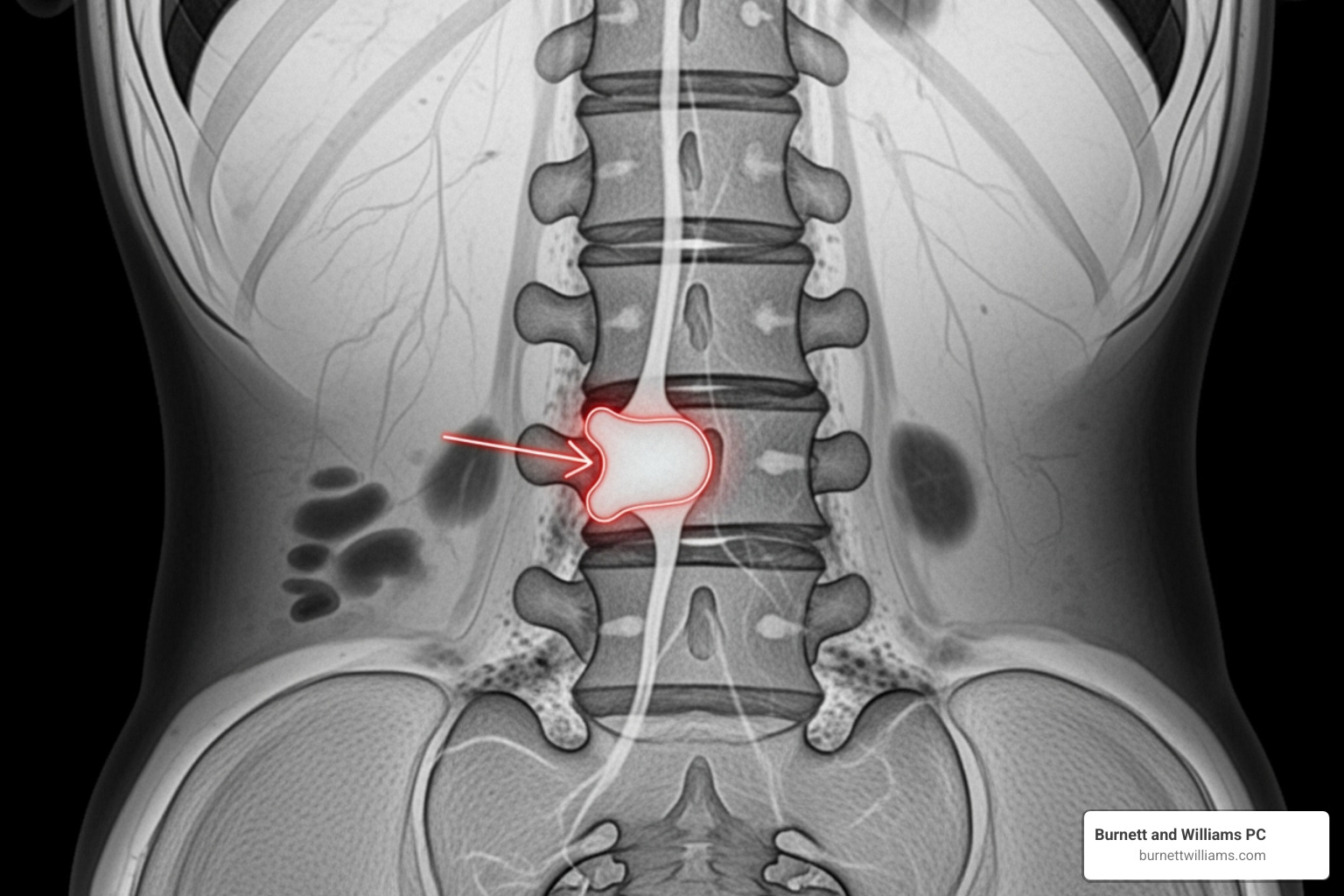
Herniated discs occur when the soft center of a spinal disc pushes through its tough outer layer due to the force of a crash. This is also known as a bulging or ruptured disc.
When the disc material presses on spinal nerves, it can cause significant pain. A herniated disc in the lower back can cause sciatica, a shooting pain down the leg. A similar injury in the neck can cause radiating pain down the arms.
Spinal Fractures and Instability
A broken vertebra, or spinal fracture, is a serious injury because the spinal cord runs through these bones. Compression fractures occur when a vertebra collapses under force, often in head-on collisions.
Spinal fractures can lead to spinal instability, meaning the spinal column cannot maintain its normal alignment. This makes movement risky and can cause a vertebra to shift forward, a condition called spondylolisthesis.
These injuries cause severe, localized pain with movement and risk permanent nerve damage if bone fragments press on the spinal cord.
Severe Spinal Cord Injuries (SCI)
A spinal cord injury (SCI) damages the bundle of nerves that carries signals between the brain and body. Unlike broken bones, nerve tissue in the spinal cord cannot be repaired by modern medicine.
An SCI can be complete, meaning total loss of sensation and motor function below the injury site, or incomplete, where some function remains.
Injuries to the thoracic spine (mid-back) often result in paraplegia, which is paralysis of the lower body. The most devastating injuries occur in the cervical spine (neck) and can cause quadriplegia, affecting all four limbs.
These injuries represent a catastrophic loss of function and independence for Virginia families. The financial burden is staggering, often requiring lifetime care. If you or a loved one has suffered an SCI, you need comprehensive medical and legal support. You can learn more in this comprehensive overview of spinal cord injuries.
Recognizing the Symptoms: What to Watch For After a Crash
Your body’s shock response after a car accident can mask serious spinal damage. Adrenaline floods your system, and you may not feel pain right away.
Many people walk away from crashes on Route 29 or I-64 feeling fine, only to wake up with severe pain or numbness days later. The delayed onset of symptoms is incredibly common with a car accident spinal injury.
Getting a prompt medical evaluation is crucial, even if you feel fine. It protects your health and creates a documented record connecting your injuries to the accident, which is vital for any future legal claim.

Immediate and Delayed Symptoms of a Car Accident Spinal Injury
Some symptoms appear right away, while others may take days or weeks to develop. Both are equally serious.
Obvious warning signs include extreme back or neck pain. Less obvious symptoms like numbness, tingling, or weakness in your arms, hands, legs, or feet suggest nerve involvement.
Loss of bladder or bowel control is a medical emergency that requires immediate hospitalization, as it indicates severe spinal cord compression.
Other red flags include difficulty breathing, muscle spasms, balance problems, or visible swelling along your spine. Do not ignore new symptoms just because a few days have passed since your accident.
How Symptoms Vary by Spinal Region
The location of your injury determines your symptoms.
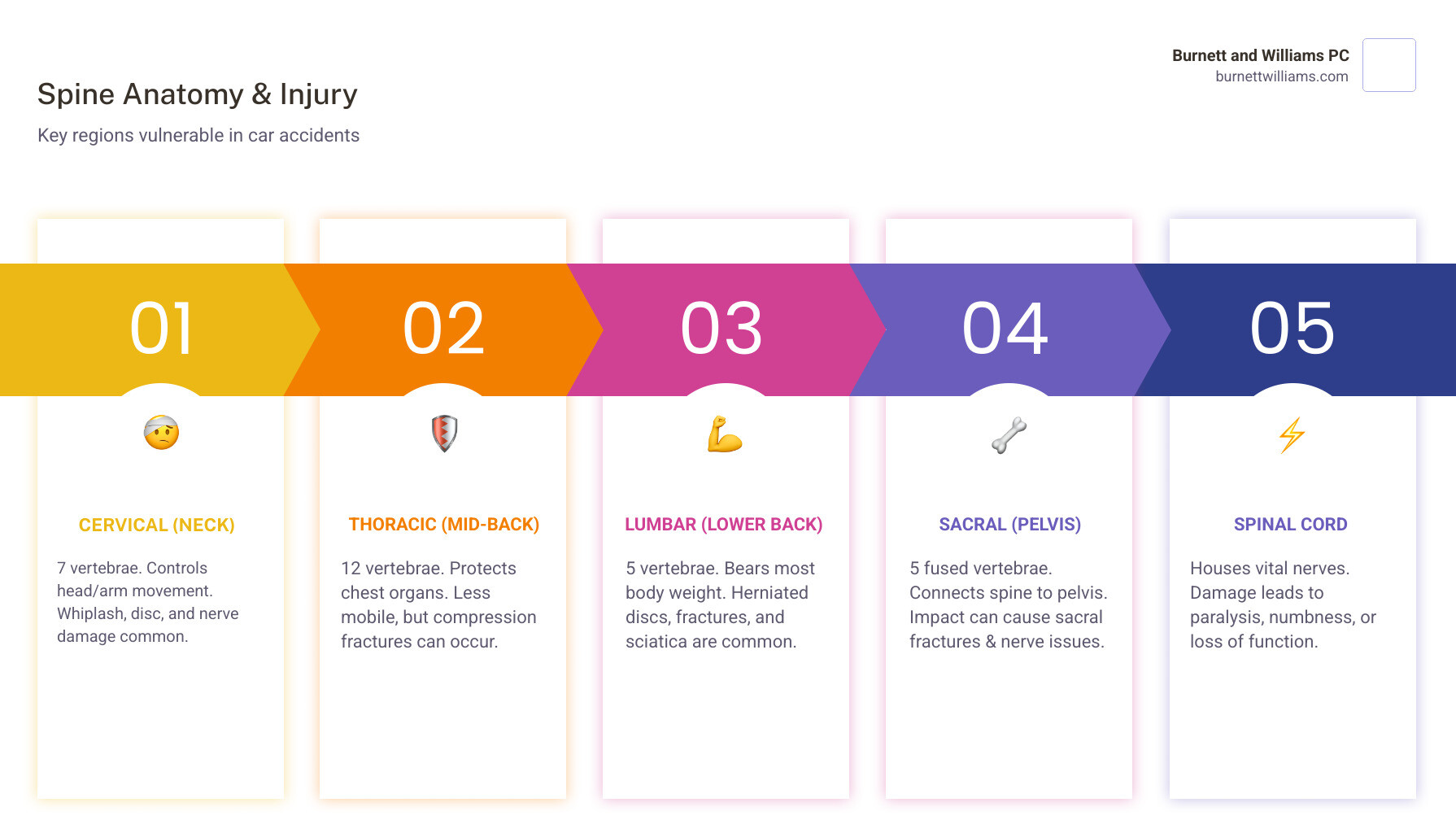
- Cervical Spine (Neck): Injuries here affect the arms and hands, causing neck pain, headaches, and weakness. Severe cases can affect breathing or lead to quadriplegia.
- Thoracic Spine (Mid-Back): Damage here impacts the torso and legs, potentially causing paraplegia and loss of sensation in the chest and abdomen.
- Lumbar Spine (Lower Back): These injuries affect the legs and hips, causing lower back pain, sciatica, and leg weakness.
- Sacral Region (Base of Spine): Injuries affect the hips, groin, and pelvic functions. Many with sacral injuries can still walk. Learn more about the sacral region.
The bottom line: if something feels wrong after a crash, trust your instincts. Your body is trying to tell you something important.
Navigating the Aftermath: Your Medical and Legal Rights in Virginia
This section explains the crucial steps to take to protect your health and legal rights after sustaining a car accident spinal injury in Virginia.
Medical Treatment and Long-Term Consequences
After a crash on any Virginia roadway, your first priority is getting emergency care. First responders will stabilize your spine for transport to a hospital for urgent evaluation.
Doctors will use diagnostic imaging like X-rays, MRIs, and CT scans to assess the damage. These images are the foundation for your treatment plan and any future legal claim.
For many spinal injuries, non-surgical treatments like physical therapy and medication are effective. However, severe injuries may require surgical intervention, such as spinal fusion or a discectomy, to stabilize the spine and relieve pressure on nerves.
The long-term consequences can be overwhelming. You may face chronic pain, permanent disability, and the need for ongoing rehabilitation or lifetime care. The costs can be substantial.
Protecting Your Claim: Virginia’s Strict Legal Standards
Understanding your legal rights in Virginia is just as important as getting medical care. Virginia’s laws are strict, and early mistakes can jeopardize your claim.
You have two years from the date of the accident to file a personal injury lawsuit. Building a complex spinal injury case takes time, so it is crucial to act promptly. Missing this deadline means you lose your right to sue.
Virginia also has a harsh contributory negligence rule. This law states that if you are found to be even slightly at fault for the accident, you cannot recover any compensation. This makes documenting your injuries and preserving evidence essential.
Insurance adjusters may try to use this rule against you. Be cautious when giving recorded statements, as your words can be used to assign you partial fault.
Before speaking with an insurer, consult with someone who understands Virginia law. Preserve all evidence, including photos, witness information, and the official crash report.
At Burnett & Williams PC, we help Virginians navigate these strict legal standards. We know how to build strong cases and involve you in every decision.
Conclusion: Taking Control After a Spinal Injury
A car accident spinal injury can change your life in an instant, requiring immediate medical attention and careful planning.
The most important step is to get a medical evaluation without delay. Adrenaline can mask serious symptoms, and what seems like a minor stiff neck could be a sign of significant spinal damage.
Prompt medical care protects your health and your legal rights. In Virginia, you have only two years to take legal action, and being found even slightly at fault can prevent you from recovering compensation. Early action is critical.
The aftermath of a spinal injury is overwhelming. Juggling appointments and bills while trying to recover is difficult, and this is when experienced legal guidance is most valuable.
At Burnett & Williams PC, we have guided many Virginia families through car accident spinal injury cases. We keep you informed and involved, focusing on responsive service and clear communication.
You should not have to navigate Virginia’s complex legal system while trying to heal. Contact a Virginia spine injury lawyer to discuss your case and let us handle the legal work while you focus on your recovery.